Key Takeaways
Choosing between tile and wood for your kitchen floor is one of the biggest remodeling decisions you’ll make. Here’s what matters:
- Tile wins for durability and water resistance. It lasts 20-25+ years and handles spills without stress. Perfect for busy households with kids and pets.
- Wood wins for warmth and visual flow. It’s softer underfoot, feels warmer, and creates seamless elegance in open-concept homes.
- The real deciding factors are simple: water risk, comfort and ergonomics, noise, and how much upkeep you’re truly willing to do.
- Cost overlaps significantly. Both range from budget-friendly to luxury. Your lifestyle matters more than your budget in this decision.
- There’s no wrong choice, just the right choice for YOU. Both materials create beautiful kitchens when they match how you actually live.
Choosing Between Tile and Wood for Your Kitchen Floor
If you are looking at your old kitchen floors and wondering what comes next, tile or wood? It can be overwhelming. Choosing between tile and wood for a kitchen floor is personal and can be a little stressful. Kitchen floors are important because they are the surface you’re going to walk on every day, cook on, clean on, and live on. Your kitchen floor sees everything: spilled coffee, dropped plates, chairs scooting, kids running in, and pets sliding around the corner like they own the place.
We’ve been designing kitchens for over 16 years at i4 Kitchen & Bath, and this question comes up in almost every consultation. Homeowners get stuck because both options are great, just in different ways.
Wood has that warm, welcoming “home” vibe. It feels cozy and high-end, making an open layout feel connected. Tile has the “go ahead, spill it, I’m fine” confidence. It’s tough, water-friendly, and built for real-life mess.
Which one is right for you? That depends on how you actually live in your kitchen. In this guide, we’ll cover durability, water resistance, comfort, maintenance, cost, and all the practical details that matter.
By the end, you’ll know exactly which option fits your lifestyle, budget, and vision.
Tile vs Wood in Kitchen Overview
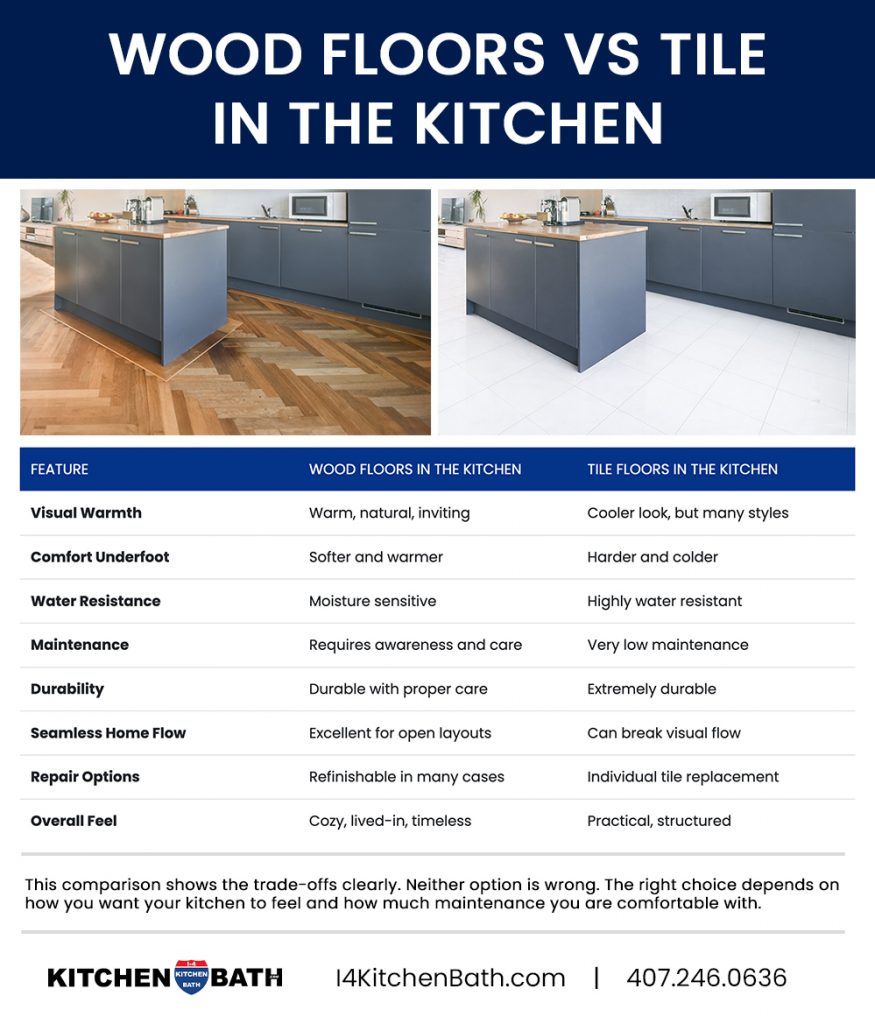
Before we get into the details, see how wood and tile stack up. If you’re in a hurry, this table gives you the highlights:
Factor | Tile Flooring | Wood Flooring |
|---|---|---|
Durability | Excellent; lasts 20-25+ years, highly resistant to wear. Impact can chip/cracks if something heavy drops. | Good; lasts 15-25 years with proper care, can be refinished. Scratches and dents are normal wear. |
Water Resistance | Excellent; porcelain is nearly waterproof, other porous tile types need sealing as well as grout | Poor; moisture-sensitive. Vulnerable to warping, staining, and damage from moisture |
Comfort & Ergonomics | Hard and cold; can cause fatigue when standing for long periods, hard on joints. Needs mats in key zones | Softer and warmer; more comfortable and easier on joints for extended standing |
Maintenance | Low; sweep and mop, grout sealing is commonly recommended every 1 to 2 years | Moderate to high; regular cleaning (sweeping and damp mopping with wood-safe cleaner), occasional refinishing for solid wood, engineered depends on wear layer |
Total Installed Cost | Materials + professional labor:Porcelain: $12 – $45+ /sq ft*Ceramic: $10 – $30+ /sq ft* | Materials + professional labor:-Hardwood floor $11 – $25+ /sq ft*-Engineered wood floor $7- $20+ /sq ft* |
Lifespan | Ceramic 20-50+ years. Porcelain and stone may last longer with proper care | With good care, solid hardwood may last 25 to 100 years. Engineered wood varies, but can last decades |
Resale Value | Appeals to practical buyers; seen as low-maintenance | Appeals to design-focused buyers; adds warmth and elegance |
Installation Time | 3-5 days for average kitchen | 2-4 days for average kitchen |
Repairing & Refinishing | Individual tiles can be replaced, matching can be tricky, regrouting is common over time | Hardwood scratches can be blended; it can be refinished every 10–15 years |
Noise Level | Louder; hard surface amplifies sound and echoes | Quieter; absorbs sound, softer acoustics, less echo |
Radiant Heat | Yes; excellent conductor, ideal for radiant systems | Possible but challenging; requires specific wood types |
Best for | Spill-prone kitchens, heavy traffic, pets, low-stress cleaning | Homeowners who want warmth, seamless flow, and are OK with quick spill cleanup |

Why Homeowners Consider Tile or Wood Floor in Kitchen
Tile or wood for your kitchen floor? Why does this decision feel so hard? Because you’re not just choosing a material. You are choosing how your kitchen feels, how it functions, and, honestly, how much money and work you want to put into installing it and maintaining it over the years.
The Emotional Pull of Wood vs the Practicality of Tile
Wood is emotional. It’s the kind of floor that makes a kitchen feel warm and inviting. They make your whole house feel connected and elegant.
Tile is practical. Tile is for the homeowner who doesn’t want to worry about spills, wet shoes, and water splashing from the sink onto the floor, because tile can take it.
Most homeowners aren’t choosing between good and bad. They’re choosing between two kinds of comfort: emotional comfort (wood) and practical comfort (tile).
The good news? In order to make the best choice, you just need to be honest about your lifestyle and real needs.
Open Concept Homes and the “Seamless Flow” Factor
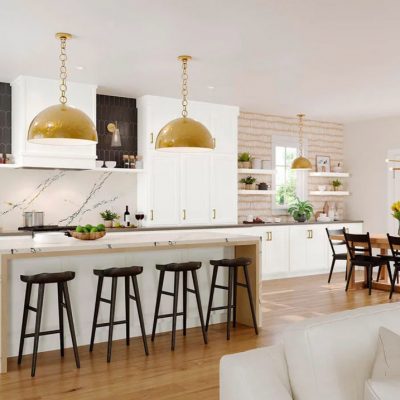
In open-concept layouts, wood creates visual continuity from the kitchen through the living areas. No transitions, just continuous flow that makes spaces feel larger.
This is wood’s biggest advantage. But it means putting moisture-sensitive material in the wettest room of your home.
The alternative? Wood-look porcelain tile in the kitchen that matches real hardwood elsewhere. You get the look with tile’s durability where you need it. (See our Wood Look Tile Kitchen guide!)
Real Life Kitchen Use: Light Use vs Heavy Daily Use
Be honest: Is your kitchen a showpiece where you cook simple dinners occasionally? Or is it the family headquarters with constant activity?
- Light-use kitchens can handle more “style-first” choices. If you don’t use the kitchen too much (simple meals, lots of dining out, less mess), wood can work beautifully.
- Heavy-use kitchens (kids, pets, lots of cooking, constant traffic, entertaining). Tile’s durability makes it a practical choice.
Your daily reality should drive this decision more than a beautiful picture on a website or in a magazine.
Pro Tip: If you host often, your kitchen turns into the gathering zone, not the living room. That means more traffic, more spills, and more chair scraping. Keep that in mind when choosing your floor.
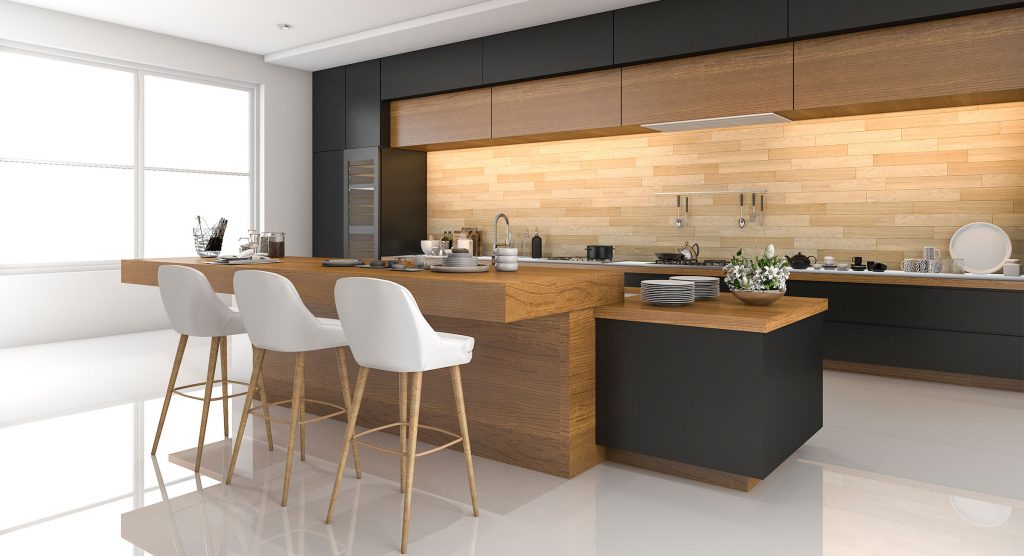
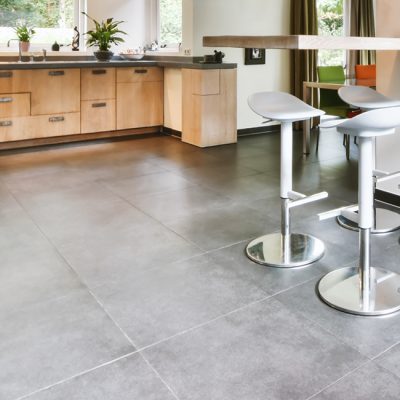
Tile Kitchen Flooring
Tile comes in a wide variety. Each type has its own personality, strengths, and price point. So, before we get into performance, let’s do a quick overview of the types of tile you usually see in kitchens.
Types of Kitchen Tile Flooring
Here’s what you’re looking at when you’re considering tile for your kitchen. We’ll start with a quick comparison, then dive deeper into the ones you’ll probably be choosing between:
| Tile Type | Durability | Water Resistance | Maintenance | Cost (Installed, USA) | Best For |
|---|---|---|---|---|---|
Porcelain | Excellent; very hard, chip-resistant | Very high, nearly waterproof | Low to moderate, grout care every 1-2 years | $12 – $45+ /sq ft* | Busy kitchens, families with kids/pets, homeowners who want durability with fewer worries |
Ceramic | Good; durable for everyday use, can chip with heavy impact | Water-resistant on the glazed surface | Low to moderate, grout care every 1-2 years | $10 – $30+ /sq ft* | Budget-friendly kitchen remodels, moderate traffic homes |
Natural Stone (slate, travertine, marble, granite) | High, but depends on stone type, can patina over time | Porous; absorbs moisture unless sealed | Moderate to high; requires careful cleaning & sealing every 1-3 yrs | $18 – $50+/sq ft* | Design-forward or luxury kitchens, homeowners committed to maintenance |
Terracotta | Moderate; softer than porcelain/ceramic, prone to chipping depending on finish | Very porous; requires regular sealing | High; needs gentle cleaning products and sealing every 6-12 months | $12 – $25+/sq ft* | Warm, rustic or Mediterranean styles, light-use kitchens, homeowners committed to maintenance |
Porcelain Tile
Porcelain is the overachiever of kitchen tiles. Fired at high temperatures (2,300°F+), it’s incredibly dense, hard, and nearly waterproof (less than 0.5% water absorption). This means puddles can sit for hours without damage.
It’s harder and more durable than ceramic, resisting chips and scratches better. Modern porcelain mimics wood, marble, or any material you want. Cost: $12 – $45+ /sq ft* installed.
In summary, porcelain is one of the most reliable kitchen flooring materials because it holds up well to heavy traffic, wet cleaning, and everyday wear.
Pro Tip (humidity): If you live in a humid climate, porcelain is a smart choice because it stays stable and moisture-resistant even when humidity swings, like we see in Central Florida.
Ceramic Tile
Ceramic offers excellent value and is available in endless colors and patterns. Made from clay fired at lower temperatures than porcelain, it’s slightly more porous but still water-resistant when glazed. Perfect for everyday kitchen use, though more prone to chipping than porcelain.
If you’re working with a budget, ceramic can still be a solid kitchen option (cost: $10 – $30+ /sq ft* installed), especially when you choose a good-quality tile and install it correctly.
Natural Stone Tile
Slate, marble, granite, and travertine bring unique luxury; each tile is one-of-a-kind. But natural stone is porous and requires sealing every 1-3 years. Marble stains easily from acidic spills. Slate and granite are more practical choices.
With an average cost of $18 – $50+/sq ft* ft installed, is best for homeowners committed to maintenance.
Terracotta Tile
Terracotta brings warmth and personality. It has that earthy, old-world charm that can make a kitchen feel instantly cozy. But terracotta is naturally porous, requiring proper care and sealing every 6-12 months. Cost: $12 – $25+/sq ft* installed.
Best for light-use kitchens in rustic or Spanish-style homes.
Durability and Chip Resistance
Tile is one of the strongest long-term kitchen flooring choices, but here’s the truth: tile is only as good as the installation under it. Properly installed tile lasts 20-50+ years. Believe it or not, we’ve seen 1960s tile in perfect condition; homeowners just wanted style updates.
How to choose a good quality tile? Porcelain & ceramic are rated on the PEI scale; Class 0 is for no foot traffic (decorative wall) and Class 5 is for heavy to extra heavy traffic. Kitchen tile should be PEI 3 or higher.
Can tile chip? Yes, if you drop something heavy at the right angle. But it’s less common than people fear, especially with porcelain. And you can replace individual tiles without having to redo the whole floor.
Water Resistance and Stain Protection
This is tile’s superpower. Porcelain absorbs less than 0.5% water. Dishwasher leaks, sink overflows, spilled pasta water; porcelain handles it all.
The weak point is grout. Unsealed grout can stain from coffee, wine, or tomato sauce. Solution: seal grout during installation and reseal every 1-2 years (takes about an hour). Or use epoxy grout, which never needs sealing.
Tile itself is nearly impossible to stain. The glazed surface is non-porous and stain-resistant.
Pro Tip: In humid climates like Central Florida, tile won’t warp, swell, or develop mold no matter how humid your kitchen gets.
Comfort and Ergonomics: Standing Fatigue, Joint Feel, Temperature
Tile is durable, but it’s also a hard surface. If you cook a lot, you’ll feel that.
Homeowners who spend time standing at the sink, stove, or island often notice:
- more foot fatigue
- more lower-back fatigue
- a colder feel underfoot in cooler climates or early mornings
Now, in warmer climates, that coolness can feel great. But comfort and ergonomics still matter if you’re cooking daily.
Pro Tip: Anti-fatigue mats at the sink and stove can make tile feel dramatically more comfortable without changing the look of your kitchen.
Noise and Acoustics: Echo, Chair Scrape, Dish Clink
Tile amplifies sound. Why? Because hard surfaces reflect noise instead of absorbing it. Open kitchens with tile echo, chairs scrape loudly, dishes clink.
Pro Tip: If you love tile but hate echo, you can soften the sound with washable runners, chair pads, and thoughtful underlayment choices like area rugs. It won’t make tile silent, but it can make the kitchen feel less “loud.”
Maintenance: Grout Care, Sealing, Cleaning Routines
Daily: Wipe spills as soon as possible, especially oils, sauces, and anything with food dye.
Weekly: Sweep or vacuum to remove grit, and mop with mild cleaner.
Yearly: Keep it clean, and reseal it.
Pro Tip: Want tile but want to think about grout less? Go bigger format tile and choose a grout color that blends. Fewer grout lines equals less scrubbing, and will make regrout faster.
Cost Expectations
Let’s go over materials, installation and some extra costs that sometimes are not expected.
Upfront Costs: Materials and Installation:
- Porcelain: $12 – $45+ /sq ft*
- Ceramic: $10 – $30+ /sq ft*
- Natural stone: $18 – $50+/sq ft*
- Terracotta: $12 – $25+/sq ft*
Maintenance Costs: Professional grout cleaning and sealing Grout sealer every 1-2 years. Average price of $1.50 to $4.00+ per sq ft*.
Long-term Costs: Minimal if tile was correctly installed. Occasional professional regrouting (every 10–15 years) averaging $5.00 – $12.00+ /sq ft* depending on scope. Individual tile replacement is rare. No major refinishing expenses.
*PRICING DISCLAIMER: Estimated U.S. price ranges covering standard to high-end projects, including materials and professional installation. Costs vary by tile grade, layout complexity, regional labor rates, and site prep requirements. Maintenance costs reflect standard cement-based grout; high-performance epoxy or pre-sealed grouts may significantly reduce or eliminate recurring sealing expenses.Advantages & Disadvantages Tile Flooring in Kitchen
| Advantages | Disadvantages |
|---|---|
Extremely water and moisture resistant | Hard and cold underfoot |
Lasts 20-50+ years | Can cause standing fatigue |
Low maintenance (sweep, mop, reseal grout) | Amplifies noise and echoes |
Stain-resistant and easy to clean | Grout requires sealing |
Thousands of design options | Can chip with heavy impact (rare) |
Pet-friendly, allergen-free | Dropped dishes break more easily |
Radiant heat compatible | Less comfortable for sitting on floor |
Good resale value | Installation can be expensive |
Best For: Who Typically Loves Tile in the Kitchen
Tile is usually ideal for:
- Busy families with kids and pets
- Messy cooks and spill-prone households
- Anyone wanting low maintenance
- Homeowners with allergies
- Humid climates
- Long-term homeowners (20+ years)
- Anyone using mobility aids
- People prioritizing durability over comfort
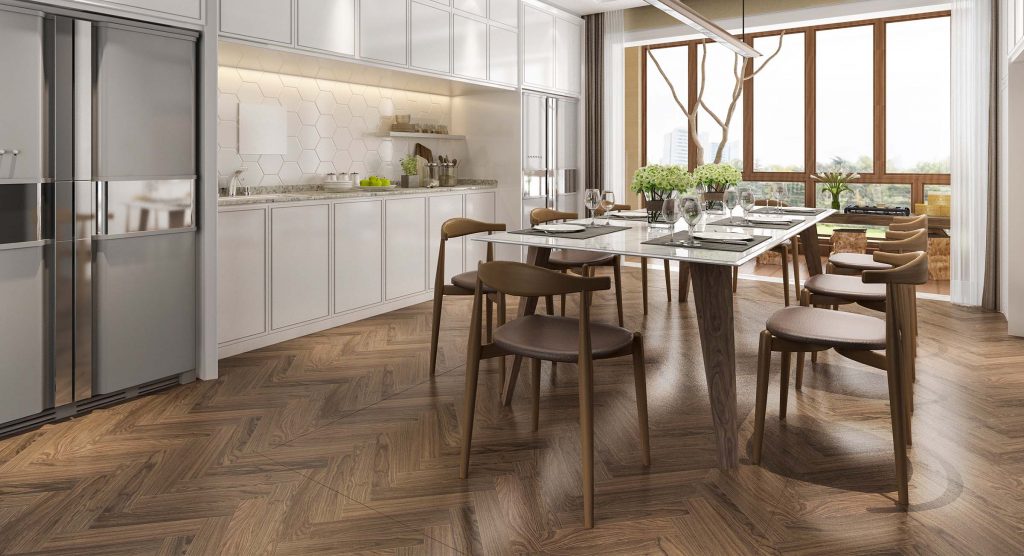
Wood Kitchen Flooring
Now let’s talk about wood. Because wood brings something to a kitchen that tile just can’t: warmth, both literal and aesthetic. There’s a reason so many homeowners are drawn to wood floors; they’re beautiful, timeless, and they make a house feel like a home.
Types of Wood Flooring Used in Kitchens
When homeowners say “wood floors,” they’re usually talking about one of two categories. And in a kitchen, that difference matters.
Engineered Wood Flooring
Engineered wood is often the more kitchen-friendly option because it’s built in layers. Real hardwood top layer (2-6mm) over cross-grain plywood base. That layered construction makes it more stable when temperature and humidity shift.
In real homes, engineered wood is popular because:
- It still gives you that warm wood look
- It tends to handle humidity swings better than solid wood
- It works really well in open floor plans where you want one continuous floor
Can be refinished 1-3 times, depending on wear layer thickness. Average cost: $7- $20+ /sq ft* installed.
Solid Hardwood Flooring
Solid hardwood is classic, no question. 3/4″ solid wood planks throughout, but it’s less forgiving in kitchens because it’s more sensitive to moisture and contracts more dramatically with humidity changes. It can still be used, you just want to go into it with realistic expectations, especially around sinks, dishwashers, and fridges.
Can be refinished 5-7+ times over its lifetime. Average cost: $11 – $25+ /sq ft* installed.
Our pro recommendation: Engineered wood for kitchens. Better moisture stability and performance where it matters most.
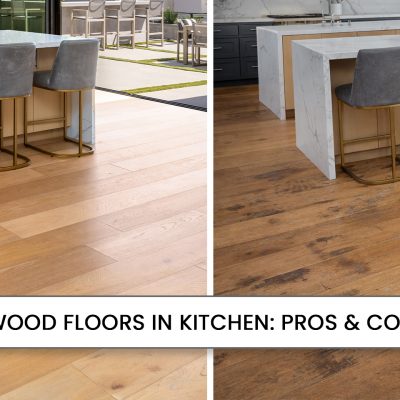
For the complete story, read: Wood Floors in Kitchen Pros and Cons.
Moisture Sensitivity: Spills, Leaks, Humidity
Wood and water don’t mix. This is the biggest concern and it’s valid.
The reality: Wipe spills within minutes, not hours. Water sitting for extended periods causes swelling, cupping, warping, and staining.
Common problem areas:
- Dishwasher leaks (often unnoticed for hours)
- Sink splashing (constant low-level moisture)
- Refrigerator water lines
- Pet water bowls
- Cooking steam and humidity
Protective measures:
- High-quality polyurethane finish
- Rugs/mats at sink, dishwasher, fridge
- Immediate spill cleanup (make it a habit)
- Humidity control (30-50% year-round)
- Regular leak inspections
Wood can work in kitchens, but requires active monitoring that tile doesn’t demand. Compared to tile where puddles can sit overnight without damage.
Scratches, Dents, and Real-Life Wear Patterns
Scratches are inevitable: chair legs, pet claws, dropped utensils, and grit tracked on shoes.
The upside: Some homeowners love that lived-in patina because it feels authentic. Others want the floor to look brand new forever. If you’re in the second group, wood can feel stressful. However, many scratches are surface-level in the finish. Wood can be refinished to look new again, a major advantage over tile.
Pro Tip: Matte and satin finishes hide wear much better than glossy finishes. Gloss makes every scratch announce itself.
Comfort and Ergonomics: Warmth, Standing Fatigue, Cooking Routines
Wood is naturally warmer, and this is where it wins hearts.
Wood generally feels:
- Warmer underfoot
- Easier on joints during long cooking sessions
- More comfortable for daily routines at the sink and stove
If you cook often, this “comfort factor” becomes a quality-of-life upgrade, not just a design choice.
Noise and Acoustics: Softer Sound, Less Echo
Wood absorbs sound instead of amplifying it. Quieter kitchen with less echo, especially important in open-concept layouts where kitchen noise carries throughout living areas.
Chair movement, footsteps, and conversation all sound softer and more natural on wood.
Maintenance Expectations: Cleaning Products, Mats, Refinishing
Wood isn’t high maintenance, but it’s habit sensitive:
Daily: Sweep or vacuum to remove grit. Wipe spills immediately.
Weekly: Barely-damp mop with wood-specific cleaner (never soak wood).
Every 7-20 years: Professional refinishing ($3-$8+/sq ft*).
Required:
- Felt pads on all furniture legs (replace every 6-12 months)
- Rugs at high-risk areas
- Wood-specific cleaning products (no harsh chemicals, no steam mops)
- Pet nail trimming
Keep in mind that refinishing is disruptive. You’ll have to move everything out, deal with dust and fumes, and you won’t be able to use the kitchen for several days. But it will make the floors look brand new.
Cost Expectations
Upfront cost ranges: material and installation
- Hardwood floor: $11 – $25+ /sq ft*
- Engineered wood floor: $7- $20+ /sq ft*
Maintenance Costs:
- Wood cleaners: $15-$30+/year*
- Felt pads: $10-$25+/year*
Long-term Costs:
- Refinishing every 7-20 years: $3-$8+/sq ft*
- This adds up but gives you new-looking floors repeatedly.
Advantages & Disadvantages of Wood Flooring in Kitchen
| Advantages | Disadvantages |
|---|---|
Timeless beauty and natural warmth | Not water-resistant; requires immediate spill cleanup |
Seamless visual flow in open concepts | Higher maintenance than tile |
Comfortable underfoot for standing | Scratches and dents from normal use |
Quieter acoustics, absorbs sound | Refinishing is disruptive and expensive |
Adds resale value | Can warp/gap with humidity changes |
Can be refinished multiple times | Finish wears in high-traffic areas |
Natural, renewable material | Not ideal for messy cooks |
Ages beautifully with character | Fades in direct sunlight |
Best For: Who Typically Loves Wood in the Kitchen
Ideal for:
- Design-focused homeowners
- Open-concept layouts needing visual flow
- Careful, tidy people who clean spills immediately
- Home cooks who stand frequently (comfort matters)
- Empty nesters or adult households
- Long-term homeowners (10-20+ years)
- Light to moderate kitchen users
- Those who appreciate natural materials and patina
For the complete story, read: Wood Floors in Kitchen Pros and Cons.
When to Choose Tile or Wood: Expert Tips From a Kitchen Remodeling Company
Start With These 5 Questions
1. How spill-prone is your kitchen, and how fast do you realistically wipe up water?
Be honest with yourself. If puddles can sit for 20 minutes while you can clean it, tile is safer. If you immediately grab a towel for every drop, wood can work.
2. How much maintenance are you actually okay with long-term?
This is the question most homeowners skip, then regret later. Are you okay with grout care and occasional sealing? Or would you rather have a floor you can mop without thinking? There’s no judgment here, just honesty about what you’ll actually do versus what you think you should do.
3. What matters more day to day: maximum durability, or comfort and ergonomics underfoot?
If you cook daily, comfort matters. Tile is durable but harder underfoot. Wood feels warmer and easier on your joints.
4. What’s your budget, and are you choosing for the next 5 years or the next 20?
If you’re planning to stay long-term, investing in what you’ll enjoy daily makes sense. If this is a shorter-term plan, practical durability and easy maintenance often win.
5. Do you want a seamless flow throughout the home, or are you okay defining the kitchen as its own zone?
Wood naturally creates continuity in open layouts. Tile can still look intentional and beautiful, but it often “defines” the kitchen more clearly unless you plan the transitions carefully.
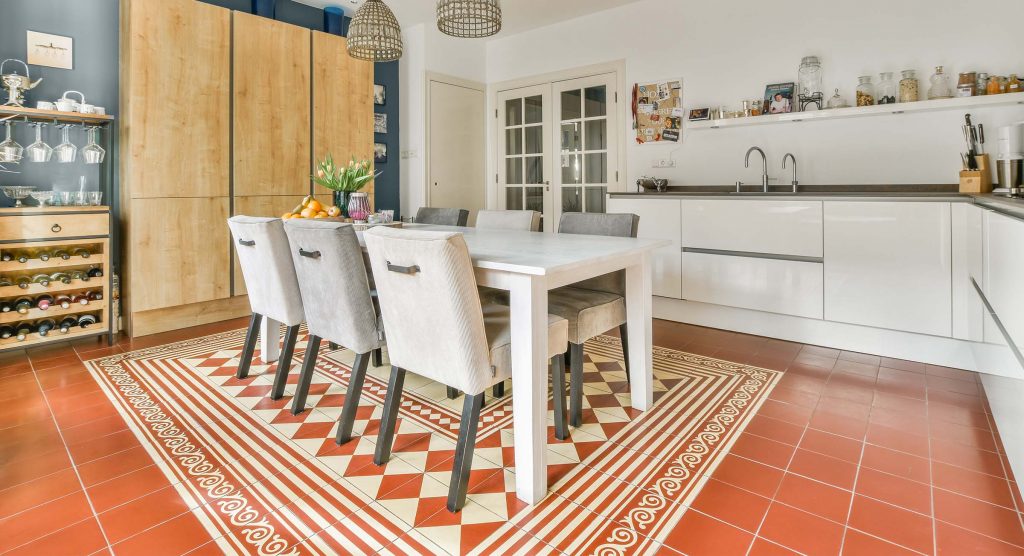
When to Choose Tile
If You Want Maximum Water Resistance
Best for spill-heavy kitchens, busy families with kids and pets, and households that mop often. Also great for entertainers and holiday hosts, spills happen fast when people gather around the island..
Pro Tip: If you want maximum water confidence, porcelain is often the safest tile category for kitchens, especially in humid climates or in locations prone to flooding, like Central Florida.
If You Want Low Maintenance
Best for homeowners who don’t want to constantly worry about cleaning the floor. Tile handles wet cleaning better than wood. Great for entertainers who want easy cleanup after gatherings.
Pro Tip: Choose larger-format tile and a grout color that blends with the tile. Fewer grout lines means less scrubbing.
If You Have Heavy Traffic, Pets, or a Spill-Prone Kitchen
This is where tile really shines. Tile is best for kitchens with constant foot traffic, pet bowls, snack zones, and frequent cooking. Ideal for entertainers, the kitchen becomes the hangout zone.
Pro Tip: Choose a finish with better slip resistance, especially with kids, older family members, or anyone wearing socks on smooth floors.
If Radiant Heat Is Part of Your Plan
Tile is the most radiant-heat friendly surface and transfers warmth efficiently throughout the floor.
Wood can work with radiant heat too, but it takes careful product selection and installation planning. Tile is generally the straightforward choice.
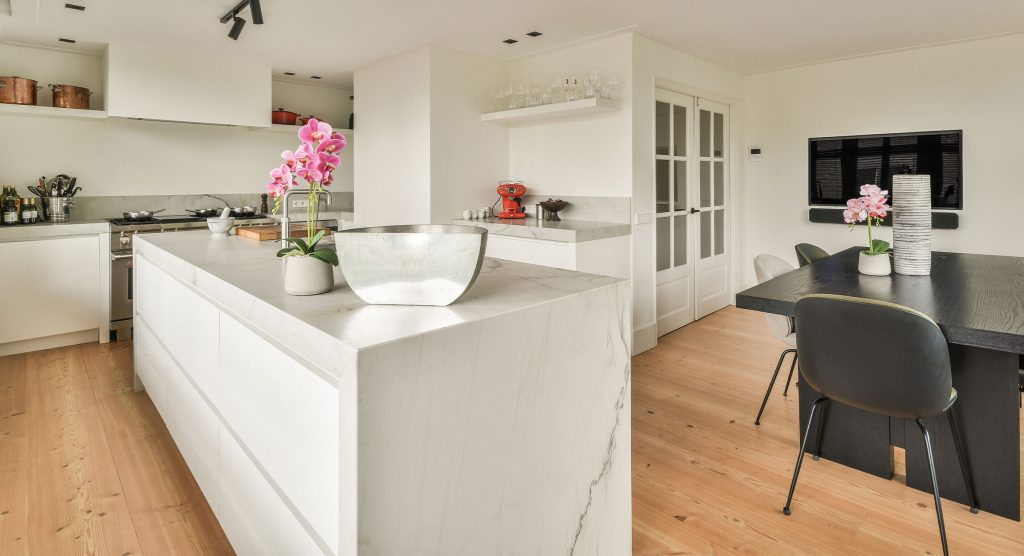
When to Choose Wood
If You Want Warmth and Comfort Underfoot
Best for home chefs who spend hours standing and cooking. Great for entertainers who want a warm, welcoming atmosphere when guests arrive.
Pro Tip: Use comfort mats at the sink and stove. They protect the floor and your feet.
If You Want a Seamless Look Throughout the Home
Wood is best for open floor plans where continuity matters. Wood keeps everything flowing from room to room. It makes the space feel bigger, calmer, and more high-end. The whole home feels connected when guests move between spaces.
Pro Tip: Plan transitions carefully near doors and wet zones. This is where many flow problems start.
If You Are Comfortable With Upkeep and Quick Spill Cleanup
Wood is not fragile, but it is habit-sensitive. If you’re the kind of homeowner who wipes spills quickly and uses the right cleaning routine, wood can be a great fit.
If spills sit often, or you’ve had appliance leaks before, tile might help you sleep better at night.
Pro Tip: Protect wet zones with washable runners near the sink and dishwasher.
If You Want the Option to Refinish Over Time
Best for long-term homeowners who like refreshing the floor instead of replacing it every 15-20 years. Refinishing brings back that brand-new look.
Just remember: refinishing depends on the type of wood floor you choose. Some engineered products can be refinished, others are more limited.
Common Kitchen Remodeling Flooring Regrets and How to Avoid Them
Regret 1: Choosing a Floor Based on Looks, Not Lifestyle
The most common regret we hear: “I chose what looked beautiful in the showroom, but it doesn’t work for how I actually cook and live.”
Avoid it: Test your decision against your real daily routine. How many spills happen in your kitchen weekly? Are you realistically going to wipe them up within 5 minutes? Do you cook for hours at a time? Answer honestly.
Regret 2: Ignoring Slip Resistance and Safety
Glossy tile or high-gloss wood finishes look stunning but become skating rinks when wet. We’ve had clients with elderly parents or young kids regret choosing slippery surfaces.
Avoid it: Choose textured tile or matte/satin wood finishes. Test samples with wet hands, if they feel slippery, they’ll be worse underfoot.
Regret 3: Underestimating Noise in Open Concept Kitchens
Tile in a large open kitchen can create an echo chamber. Every chair scrape, dish clink, and conversation amplifies throughout your living space.
Avoid it: If you have an open-concept layout, plan acoustic solutions upfront: area rugs, felt pads, soft furnishings, or choose wood for better sound absorption.
Regret 4: Skipping Installation Details to Save Money
DIY tile installation or hiring the cheapest installer often leads to problems: uneven tiles, lippage (edges at different heights), poor grout work, or improper subfloor prep that causes cracking.
Avoid it: Installation matters as much as materials. Choose certified installers to ensure proper subfloor prep, moisture barriers, and flawless execution. It’s worth the investment.
Tile Vs Wood In Kitchen FAQs
Tile lasts longer, typically 20-50+ years with minimal maintenance. Wood lasts 15-25 years but can be refinished multiple times to extend life. Porcelain tile shows virtually no wear over decades, while wood develops patina and requires periodic refinishing to maintain appearance.
Both add value. Tile attracts practical buyers concerned with maintenance and durability (families, pet owners). Wood appeals to design-focused buyers expecting continuity in open-concept homes. Match your neighborhood standard for safest resale value. In humid regions, tile may appeal more broadly.
Tile stays cooler than wood, which some love (especially in warm climates) and others dislike. Solutions: wear slippers or socks, use area rugs, or install radiant heating underneath. In climates like Florida, tile’s coolness is actually refreshing most of the year.
Not necessarily. Wood works well in light-use kitchens with tidy households who wipe spills immediately. It becomes problematic in high-traffic, spill-prone kitchens with kids and pets, or for homeowners who don’t want maintenance. Be honest about your lifestyle before deciding.
Tile is better for busy households. It handles spills, pet accidents, dropped items, and heavy traffic without stress. You can relax knowing daily chaos won’t damage your floor. Wood requires immediate spill cleanup and careful maintenance, which can be challenging in busy environments with pets or kids.
Both can work, but tile is better. Tile conducts heat efficiently and evenly without risk of warping. Wood can be used with radiant heat but requires specific wood types, careful installation, and humidity control. Some wood manufacturers void warranties if used with radiant systems.
Wood is significantly quieter. It absorbs sound while tile reflects it, creating echo and amplifying noise. In open layouts where kitchen noise carries to living areas, wood’s acoustic properties create a more peaceful environment for conversations and daily life.
Wood is slightly more forgiving due to minimal give in the material. But keep in mind that dropped dishes and glasses break on both surfaces. The difference is marginal. Tile’s harder surface may be slightly more likely to shatter delicate items.
Wood-look porcelain tile offers an excellent compromise: wood aesthetics with tile’s durability and water resistance. Modern technology makes them nearly indistinguishable from real wood. Ideal for open-concept homes where you want visual flow but need performance in the kitchen.
Tile is typically more cost-effective long-term. Lower maintenance costs (just grout sealing) and no refinishing expenses. Wood requires refinishing every 7-20 years ($3-$8/sq ft*), plus ongoing careful maintenance. Upfront costs overlap significantly, but tile’s minimal long-term costs add up to savings over 20+ years.
Conclusion: The Best Kitchen Floor Is the One That Matches Your Lifestyle
Tile vs wood isn’t about which material is “better.” It’s about which one supports your daily life.
If your kitchen is busy, messy, and you want peace of mind, tile can be the easiest floor to live with. If you want warmth, comfort, and that seamless open concept look, wood can be absolutely worth it.
Both create beautiful kitchens. We’ve designed stunning spaces with each at i4 Kitchen & Bath. What matters is choosing the one you’ll love living with for the next 15-25 years.
Ready to Remodel Your Kitchen?
If you’re still deciding, seeing materials in person makes everything clearer: the textures, the finishes, the slip resistance, even the way light hits the surface.
At i4 Kitchen and Bath, we help homeowners compare tile and wood options in a practical, no-pressure way, based on lifestyle, budget, and long-term goals. If you’re planning a full remodel, flooring decisions get even easier when they’re part of the bigger picture.
Schedule a free consultation by calling (407) 246-0636 or filling out a contact form, and let’s help you choose a floor you’ll love living with.
*PRICING DISCLAIMER: Prices are national USA averages. They are an approximate cost at the time this article was written. Prices are affected by materials, professional installation, location and project complexity.