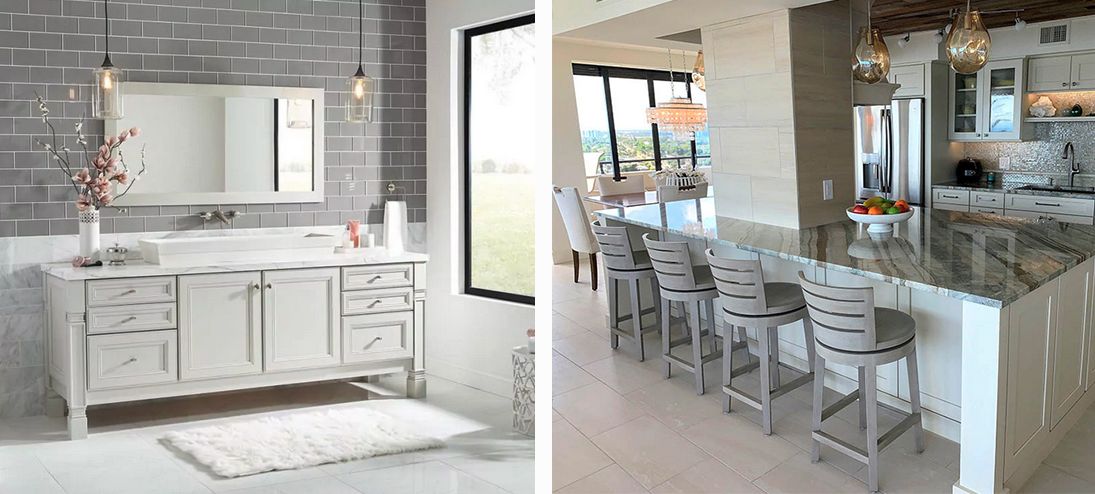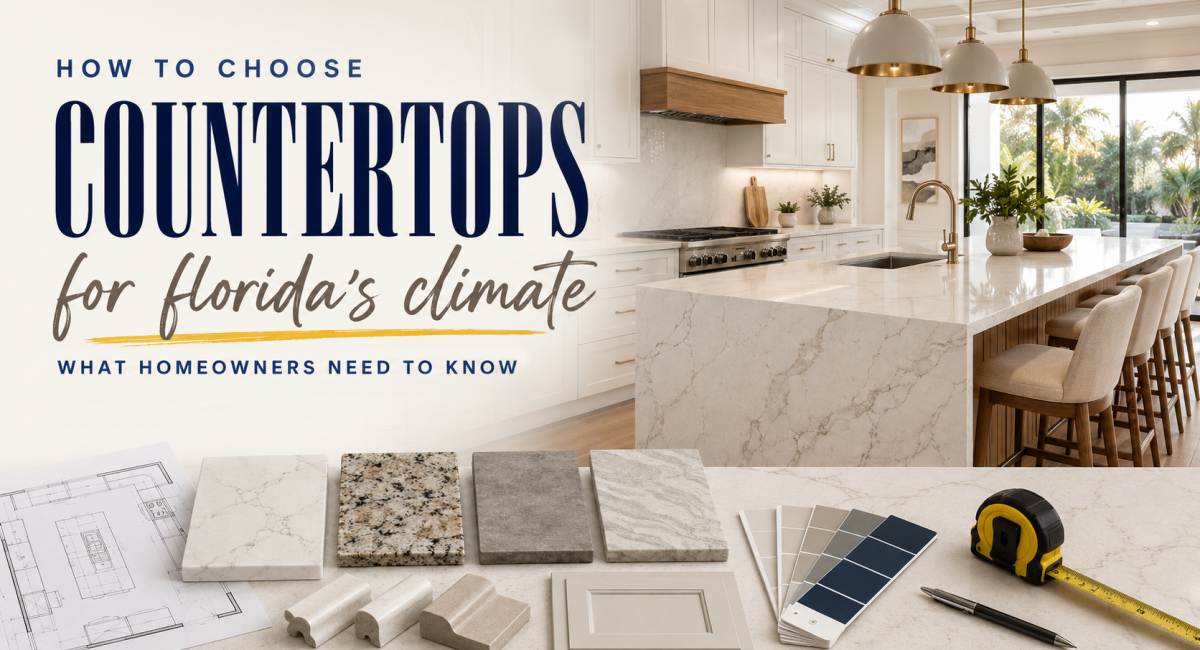
To choose countertops for Florida’s climate, prioritize non-porous materials like quartz or porcelain that resist humidity and require no sealing. Porous natural stones like granite and quartzite perform well but need annual sealing in Florida’s humid conditions. Avoid marble, wood, and limestone in high-humidity kitchens. A polished finish is more practical than honed in a subtropical kitchen.
If you are planning a kitchen remodel in Orlando, or anywhere in Florida, the first question is not “what color do I want?” It is “what material actually works here?” Florida’s subtropical climate, with its year-round humidity, intense heat, and strong UV exposure, affects countertop materials in ways most national buying guides never mention. This article gives you the local answer before you go any further.
Key Takeaways: Best Countertops for Orlando and Central Florida Homes
- Florida’s humidity, heat, and UV exposure make climate the most important filter when choosing countertop materials.
- Non-porous materials like quartz and porcelain handle Florida’s indoor kitchen conditions with little to no maintenance.
- Quartz performs excellently in indoor Florida kitchens but is not recommended for outdoor kitchens or areas with prolonged direct sun exposure. For those applications, porcelain or granite are safer choices.
- Porous natural stones like granite and quartzite perform well in Florida but require sealing, typically once a year in humid conditions.
- Materials like marble, wood, and limestone carry higher maintenance risks in a subtropical kitchen.
- A polished finish outperforms honed in Florida kitchens for everyday practicality and moisture resistance.
- In our experience working with Orlando homeowners, quartz is the material that consistently performs best in Florida’s climate and requires the least ongoing maintenance.
- Seeing materials in person under real light before deciding makes a significant difference in the final result.
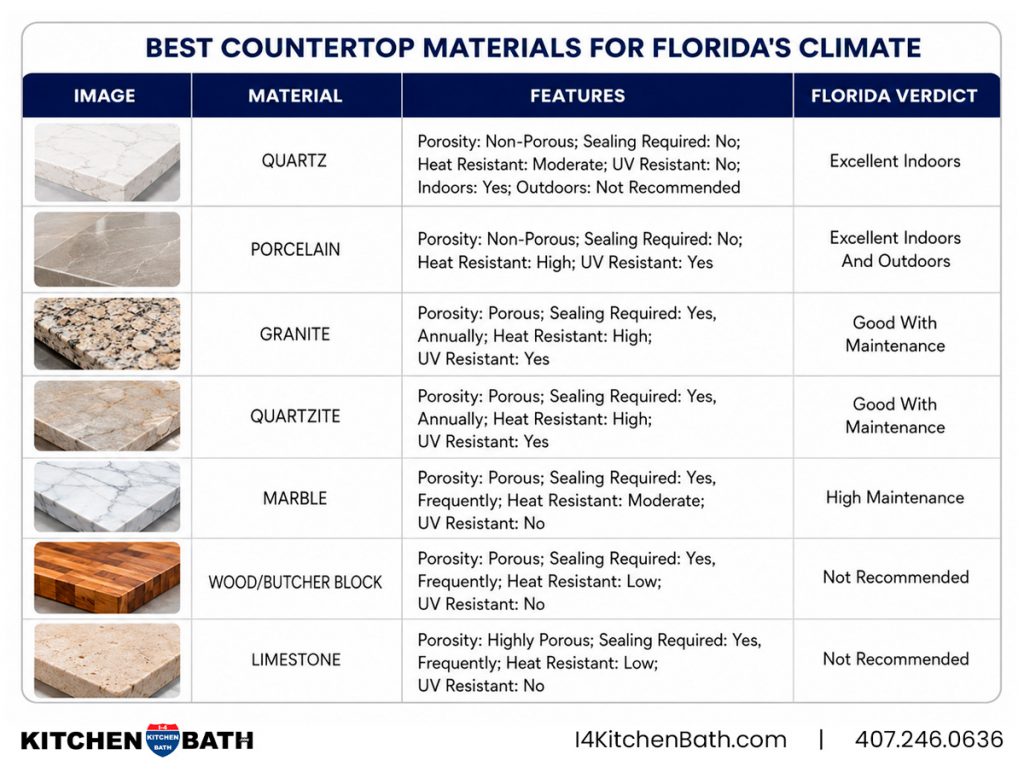
Best Countertop Materials for Florida’s Climate Overview
| Material | Porosity | Sealing Required | Heat Resistant | UV Resistant | Florida Verdict |
|---|---|---|---|---|---|
| Quartz | Non-porous | No | Moderate | Indoors: Yes Outdoors: Not recommended | Excellent indoors |
| Porcelain | Non-porous | No | High | Yes | Excellent indoors and outdoors |
| Granite | Porous | Yes, frequency varies | High | Yes | Good with maintenance |
| Quartzite | Porous | Yes, frequency varies | High | Yes | Good with maintenance |
| Marble | Porous | Yes, frequently | Moderate | No | High maintenance |
| Wood/Butcher Block | Porous | Yes, frequently | Low | No | Not recommended |
| Limestone | Highly porous | Yes, frequently | Low | No | Not recommended |
Why Countertop Selection Is Different in Orlando
Countertop selection in Orlando is different because Florida’s subtropical climate, with high morning humidity, intense heat, and strong UV exposure throughout the year, affects how every surface material performs over time. According to the Florida Climate Center at Florida State University, using data provided by the National Oceanic and Atmospheric Administration (NOAA), Orlando’s average morning relative humidity ranges from approximately 85 to 91 percent year-round, though afternoons are significantly drier, typically between 47 and 61 percent. The wrong material choice in a Florida kitchen can mean staining, warping, discoloration, or constant maintenance that a drier climate would never demand.
Most countertop guides are written for a generic American homeowner. But if you live in Orlando, Winter Park, Dr. Phillips, Lake Mary, or anywhere across Central Florida, you are not a generic homeowner. You live in one of the most humid, sun-drenched climates in the country, and that changes everything.
What Makes Florida’s Climate Unlike Most of the Country
Florida is a subtropical state, and Orlando sits right in the middle of it. If you have lived here for any length of time, you already know what Florida humidity does to things. Wood swells. Paint peels. And countertop materials that look beautiful in a showroom up north can behave very differently once they are living in a Florida kitchen year-round.
Morning humidity here is consistently high, and even though afternoons are significantly drier, the overall moisture level in the air remains higher than most of the country for most of the year. Add intense summer heat, frequent afternoon rain, and direct sunlight through windows and skylights, and you have conditions that genuinely test how a surface material holds up over time
Why Humidity Resistance Should Be the First Thing You Consider
The material that works beautifully in a dry Arizona kitchen or a temperate Pacific Northwest home might give you real headaches here in Orlando. That is why at i4 Kitchen & Bath, we always start with climate before we ever talk about colors, finishes, or brands.
You are not just picking a countertop. You are choosing something you will live with every day, and it needs to make sense for the way homes work here in Florida. The right material should look good, handle the heat and humidity, and still feel like a good decision years from now.
The 4 Factors That Drive Every Countertop Decision in Florida
These are the four things that should shape your material decision before you ever look at colors or finishes. Each one is specific to Florida’s climate and lifestyle, and each one narrows your options in a practical, helpful way.
1. Humidity and Moisture Resistance
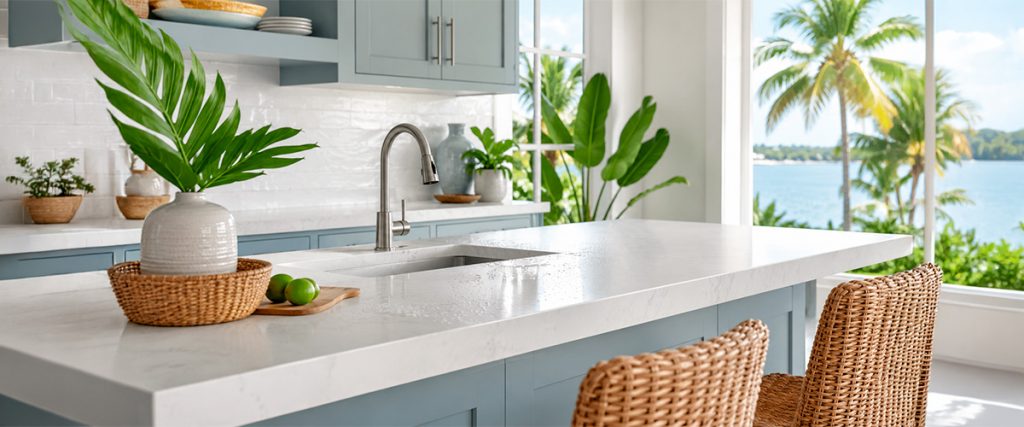
The single most important factor for Florida kitchens is how a countertop material responds to moisture. The key concept here is porosity, and it is simpler than it sounds.
Think of a porous material like a sponge. It has tiny openings on the surface that absorb liquid. In Florida’s humidity, that is not what you want. Over time, a porous countertop in a humid kitchen can absorb moisture from the air, from spills, and from cleaning. That leads to staining, discoloration, and in some cases, mold growth underneath the surface where you cannot see it.
Non-porous materials work the opposite way. Their surface has no openings to absorb liquid or moisture. Quartz and porcelain are both non-porous by nature. Granite and quartzite are porous natural stones but can be made moisture-resistant with proper sealing. Marble, limestone, and wood are porous and much harder to protect in a consistently humid environment.
In our experience working with Orlando homeowners, the first question we ask is always about maintenance tolerance. If you want a surface that handles Florida’s humidity with zero extra effort, non-porous is the answer.
2. Heat and UV Exposure in Florida Kitchens
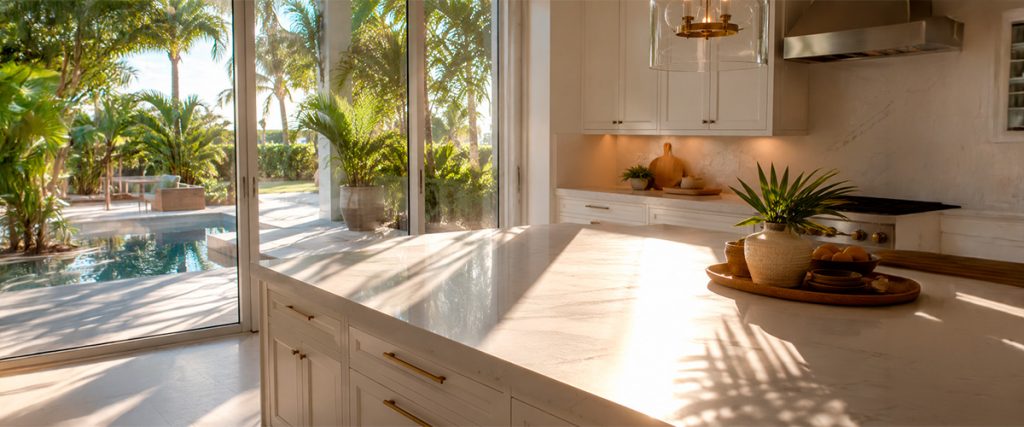
Florida kitchens deal with two kinds of heat: cooking heat from the stove and oven, and ambient heat from the Florida sun coming through windows and skylights. Both matter, but they affect materials differently.
Cooking heat is a concern for any countertop material, and how a surface handles sudden or prolonged heat exposure varies significantly by material. Some surfaces contain resin binders that are sensitive to high heat, while natural stone and porcelain generally handle cooking heat more readily. Whatever material you choose, using trivets and hot pads near the stove is a simple habit that protects any countertop surface long term.
UV exposure from direct sunlight through windows is a separate issue. Standard indoor quartz performs well in most Florida kitchens, but surfaces exposed to prolonged direct sunlight through large south- or west-facing windows can show subtle discoloration over many years. For outdoor kitchens or spaces with strong direct sun exposure, porcelain or granite are safer long-term choices. Most standard engineered quartz is designed for interior use, and many manufacturers note that extensive UV exposure can damage surfaces not rated for outdoor use. Some brands do offer outdoor-rated collections, so if you are considering quartz for an outdoor space, always verify with your fabricator whether that specific product is rated for exterior use.
3. Kitchen Size and Natural Light in Orlando Homes
Many Orlando homes feature open-plan layouts with large windows that bring in generous natural light. That is one of the things people love most about Florida living! But it also means your countertop color and material finish interact with light in ways that matter more here than in darker, more enclosed kitchens.
Lighter colored countertops amplify natural brightness and make a kitchen feel more open and airy, which works beautifully in Florida’s open floor plans. Darker countertops absorb light and add drama, but they can make a smaller kitchen feel heavier, especially in spaces that do not get as much natural light.
This is not just a style consideration. It is a practical one. At i4 Kitchen & Bath, we always encourage homeowners to bring countertop samples home and look at them in their actual kitchen at different times of day before making a final decision. Morning light and afternoon light in a Florida home can look completely different, and that difference matters.
4. Your Household Lifestyle: Kids, Cooking, Entertaining Year-Round
One thing that makes Central Florida homeowners different from homeowners in most of the country is that entertaining here is not a seasonal activity. It is year-round. Backyard barbecues in January, pool parties in April, holiday gatherings in December. The kitchen never really gets a break.
Keep that in mind when you are choosing a countertop. Some surfaces look beautiful in a quiet kitchen, but real life can be a little rougher than that. If your family cooks often, has people over, or has kids spreading out homework, snacks, and art projects across the island, you need a countertop that can keep up.
For busy Central Florida homes, you want a countertop that can handle everyday life. Scratches, spills, quick cleanups, kids, guests, dinner prep, all of it. That is why scratch resistance, stain resistance, and easy cleaning are so important.
From what we see in Orlando homes, quartz is usually the easiest material to live with. It holds up well, looks beautiful, and does not ask for much maintenance. We also carry other countertop materials, and our team can walk you through each option at our Orlando showroom so you can choose what feels right for your home.
Countertop Materials That Thrive in Florida’s Climate
Not every countertop material is built for subtropical conditions. Here is a straightforward look at which materials hold up best in Florida kitchens and why.
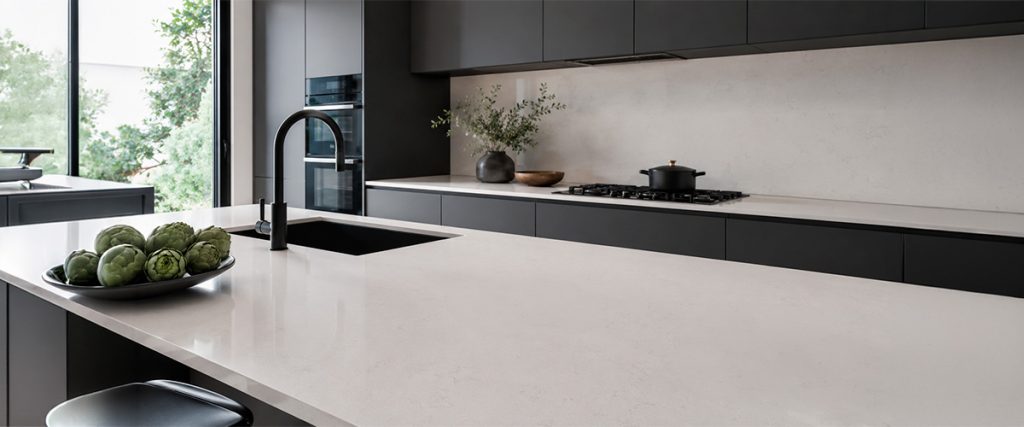
Quartz: Non-Porous and Low Maintenance
Quartz is the material we recommend most often to Orlando homeowners, and for good reason. It is non-porous, which means it does not absorb moisture and is resistant to bacteria, mold, and mildew, making it one of the most hygienic countertop surfaces available. It requires no sealing and is easy to keep clean. For routine daily cleaning, warm water, mild soap, and a soft cloth are all you need. For tougher messes, a manufacturer-approved cleaner does the job without any special treatment or reconditioning.
The one thing to keep in mind is heat. Quartz is heat-resistant but not heatproof, so trivets are always recommended near the stove. For indoor Florida kitchens, quartz is consistently one of the strongest performing materials available. If you are ready to go deeper on choosing the right quartz color, finish, thickness, and edge profile for your specific kitchen, our full guide on how to choose quartz countertops in Orlando walks you through every decision.
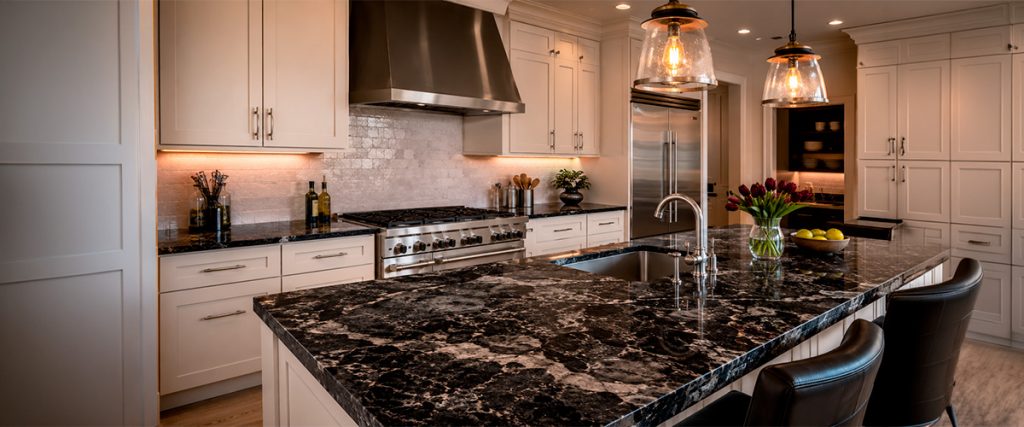
Granite: Durable but Requires Sealing
Granite is a natural stone that handles Florida’s heat and humidity well, but it does require maintenance. Because it is a porous material, granite needs to be sealed periodically to prevent moisture absorption, staining, and discoloration over time. How often depends on the specific stone, the sealer used, the surface finish, and how heavily the kitchen is used. A simple water test every few months tells you when it is time to reseal.
For homeowners who love the look of natural stone and are comfortable with that maintenance commitment, granite is a strong and durable choice. It is also fully UV stable, which makes it a good option for kitchens with strong direct sun exposure or for outdoor kitchen applications.
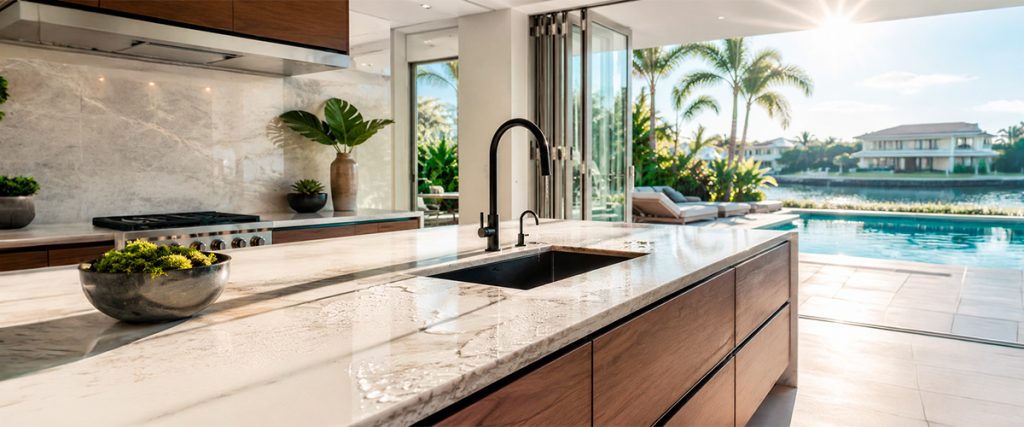
Porcelain: Waterproof and UV Resistant
Porcelain is one of the fastest-growing countertop choices in Florida, and it is easy to see why. It is completely waterproof, non-porous, and one of the few countertop materials that is genuinely UV resistant, making it an excellent choice for both indoor kitchens and outdoor spaces with direct sun exposure.
If you have a covered outdoor kitchen, a lanai, or a kitchen with large south or west-facing windows that get strong afternoon sun, porcelain is worth serious consideration. It handles Florida’s conditions with virtually no maintenance and holds its color and finish far better than most materials under prolonged sun exposure.
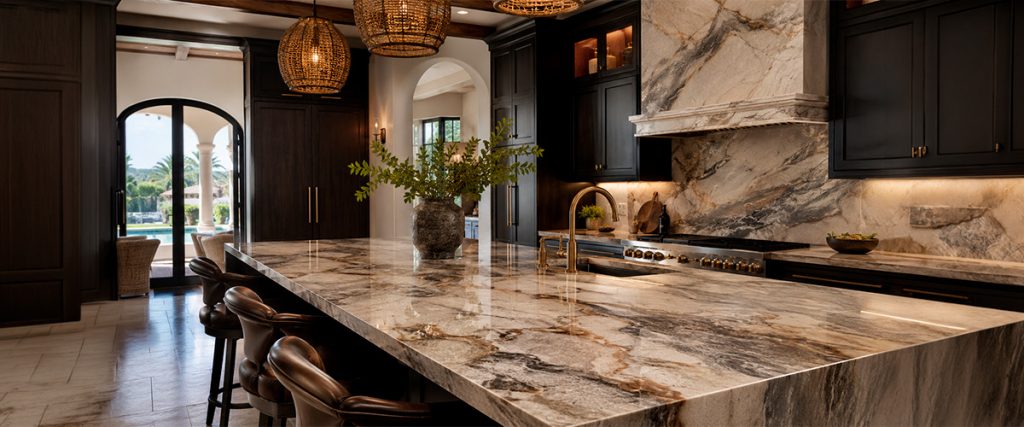
Quartzite: High Durability With Proper Sealing
Quartzite is a natural stone that is often confused with quartz, but they are very different materials. Quartzite is quarried from the earth like granite, and it is known for its high durability and UV stability. It is moisture resistant when properly sealed, making it a solid performer in Florida kitchens.
Like granite, quartzite requires periodic sealing to maintain that moisture resistance in humid conditions. How often depends on the specific stone, the sealer used, and how heavily the kitchen is used. A simple water test every few months tells you when it is time to reseal. It is a beautiful, high-end option for homeowners who want the look of natural stone with strong long-term durability.
Countertop Materials That Struggle in Florida’s Climate
Some materials that look stunning in design magazines are simply not the best fit for a Florida kitchen. Here is what to know before you fall in love with one of them.
Marble: Beautiful but High Maintenance in Humidity
Marble is one of the most beautiful countertop materials available, and we completely understand the appeal. But in a busy kitchen, it requires a serious maintenance commitment. Marble is a soft, porous stone prone to staining from spills and discoloration if not sealed regularly. More importantly, acidic foods and drinks like lemon juice, vinegar, and wine can etch marble’s surface, dulling its finish even when the stone is properly sealed. Florida’s humidity adds to the challenge, but the bigger day-to-day risks are spills, acidic foods, and cleaning habits that marble simply does not forgive easily.
For most Orlando homeowners who want a low-maintenance kitchen, marble is a challenging choice. If you love the marble look, veined quartz gives you that same elegance without the upkeep.
Wood and Butcher Block: Risky in a Subtropical Kitchen
Wood is warm, beautiful, and full of character. Walk into a farmhouse kitchen with a butcher block island, and you immediately feel it. But in a Florida kitchen, wood countertops come with real challenges that are worth understanding before you fall in love with the look.
Wood is a porous, living material that expands and contracts in response to moisture and temperature changes. In Orlando’s climate, where humidity cycles daily and the air stays consistently moist for much of the year, that movement never really stops. Over time, that constant expansion and contraction can cause wood countertops to warp, crack, and develop gaps at joints and seams.
Everyday kitchen use adds to the risk. Standing water around the sink, spills that are not wiped up immediately, or a wet sponge left sitting on the surface can all allow moisture to penetrate the wood. Without meticulous sealing and regular oiling, that moisture creates conditions where mold and mildew can develop, sometimes in places you cannot easily see.
Wood can work in a Florida kitchen with the right maintenance routine, but that routine is demanding. It is not a set-it-and-forget-it surface. If you are looking for something warm and natural in feel, there are materials that give you that aesthetic with far less upkeep in a subtropical climate.
At i4 Kitchen & Bath, we do not recommend wood or butcher block for Orlando kitchens. The maintenance demands in a subtropical climate are simply too high for most households.
Limestone: Too Porous for Florida Conditions
Limestone is highly porous and one of the most moisture-absorbent countertop materials available. In Florida’s humidity, it requires frequent sealing and still remains vulnerable to staining, etching, and moisture damage. For most Central Florida homeowners, the maintenance commitment is not worth it when stronger-performing materials are readily available.
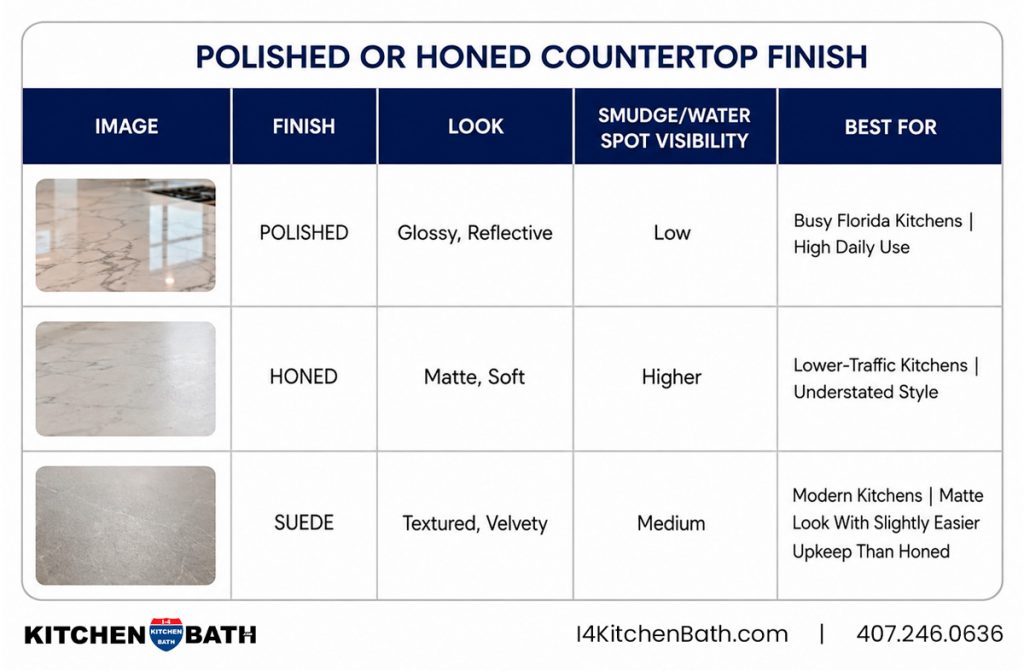
Polished or Honed Countertop Finish: Which Works Better in Florida?
For most Florida kitchens, a polished finish is the more practical choice. Polished quartz and granite have a glossy, reflective surface that resists moisture better, wipes clean instantly, and reflects the natural light that Florida homes are known for. In a kitchen that sees daily use, that ease of maintenance makes a real difference.
A honed finish is matte and soft to the touch, and it is genuinely beautiful. But in a Florida kitchen, it shows water spots, fingerprints, and smudges more readily than polished. That matters more here than in drier climates because moisture, whether from cooking, cleaning, or just the air, is a constant presence in a subtropical kitchen.
Here is a simple comparison:
| Finish | Look | Smudge and Water Spot Visibility | Best For |
|---|---|---|---|
| Polished | Glossy, reflective | Low | Busy Florida kitchens, high daily use |
| Honed | Matte, soft | Higher | Lower-traffic kitchens, understated style |
| Suede | Textured, velvety | Medium | Modern kitchens, matte look with slightly easier upkeep than honed |
At i4 Kitchen & Bath, our design team recommends the polished finish as the first choice for most Orlando homeowners. It is not that honed is a bad choice. It is that polished simply performs better day to day in Florida’s conditions. If you love the matte look, suede finish is a great middle ground. It gives you that softer aesthetic without showing every water spot and fingerprint that honed tends to reveal in a busy kitchen.
Maintenance Tips for Long-Lasting Countertops in Orlando
Florida’s climate means your countertops work harder than they would in most parts of the country. Here is what to do to keep them looking their best for the long term.
Non-Porous Surfaces: What to Do and What to Avoid
Non-porous surfaces like quartz and porcelain are the easiest to maintain in a Florida kitchen. For routine daily cleaning, warm water, mild soap, and a soft cloth are all you need. For tougher messes, grease buildup, or hard water spots, a manufacturer-approved cleaner handles the job without any special treatment or reconditioning.
What to avoid: bleach-based cleaners, abrasive scrubbing pads, and strong solvents like paint thinner or nail polish remover. These can dull the finish over time. And even though quartz is heat-resistant, always use a trivet near the stove. It is a simple habit that protects your surface for decades.
Natural Stone in Florida: How Often to Seal and Why It Matters
If you choose granite or quartzite for your Florida kitchen, sealing is not optional. It is what keeps a porous natural stone performing well in a humid climate.
How often you need to reseal depends on the specific stone, the sealer used, the surface finish, and how heavily the kitchen is used. Per the Natural Stone Institute, some quality sealers can have a life expectancy of 10 to 15 years, while others may need more frequent reapplication. The best way to know is a simple water test: sprinkle a few drops of water on the surface and leave it for 15 to 30 minutes. If the water beads up, the seal is holding. If the water absorbs into the stone, it is time to reseal.
Staying on top of sealing in Orlando’s humid conditions is what keeps natural stone looking beautiful for decades.
Orlando’s Indoor-Outdoor Lifestyle and What It Means for Your Countertops
One thing that makes Central Florida homeowners truly unique is how they live. In most parts of the country, outdoor entertaining is a summer thing. Here in Orlando, it is a year-round thing. January barbecues, spring pool parties, fall gatherings on the lanai. The line between indoors and outdoors is blurry here, and that affects how your kitchen gets used and what your countertops need to handle.
Year-Round Entertaining and Durability
When your kitchen sees heavy use twelve months a year, not just during the holiday season, durability stops being a nice-to-have and becomes essential. Scratch resistance, stain resistance, and surfaces that clean up quickly between uses matter more in a household that entertains constantly than in one that uses the kitchen casually.
This is one of the reasons quartz performs so well for Central Florida homeowners. It handles heavy daily use without demanding anything extra in return. Your countertop should keep up with your lifestyle, not slow it down.
Sun-Drenched Kitchens and UV Resistance
Florida homes are designed to bring the outside in. Large windows, sliding glass doors, skylights, and open floor plans mean that natural light, and with it UV exposure, is part of daily life in an Orlando kitchen.
For indoor kitchens, most countertop materials handle indirect sunlight without issue. But if your kitchen has large south- or west-facing windows that let in strong direct afternoon sun for several hours a day, UV resistance becomes a real consideration. Porcelain and granite are naturally UV stable. Standard quartz performs well in most indoor conditions, but prolonged direct sun exposure over many years can cause subtle discoloration in some products. When in doubt, ask your designer about the specific product’s UV performance before deciding.
What to Do Next: Find the Right Countertop for Your Florida Kitchen
You now have a clear picture of how Florida’s climate affects every countertop material. The next step depends on where you are in your decision journey.
Already Leaning Toward Quartz?
Great choice for Florida! Quartz is non-porous, low maintenance, and consistently one of the strongest performers in Orlando kitchens. The next step is choosing the right color, finish, thickness, and edge profile for your specific space. Our full guide on how to choose quartz countertops in Orlando walks you through every decision.
Still Comparing Materials?
No problem at all. Taking the time to compare is always worth it. We cover quartz, granite, and marble side by side in our full Orlando comparison guide on quartz vs granite vs marble in Orlando, so you can see exactly how each material stacks up before you commit.
Renovate With Confidence
High-quality craftsmanship, smart design, and clear communication. Schedule a free consultation by calling (407) 246-0636 or filling out a contact form.
Countertops for Florida’s Climate FAQs
These are the questions we hear most often from Orlando and Central Florida homeowners who are just starting their countertop research.
How does Florida humidity affect kitchen countertops?
Florida’s humidity causes porous countertop materials to absorb moisture over time, leading to staining, discoloration, and in some cases, mold growth. Non-porous materials like quartz and porcelain resist moisture absorption and require no sealing. According to the Florida Climate Center at Florida State University, Orlando’s average morning humidity ranges from 85 to 91 percent year-round.
What is the best countertop material for Florida’s humid climate?
For a humid climate like Orlando’s, quartz and porcelain are the strongest choices. Both are non-porous, require no sealing, and resist moisture with minimal maintenance. Granite and quartzite also perform well with proper annual sealing. Marble, wood, and limestone are the most challenging materials to maintain in humid conditions.
Do countertops get damaged by Florida heat?
It depends on the material. Granite and porcelain handle heat well. Quartz is heat-resistant but not heatproof. Its resin binders can be damaged by sudden or prolonged high heat, so trivets are always recommended. Wood is the most vulnerable to Florida’s combination of heat and humidity.
What does non-porous mean and why does it matter in Florida?
A non-porous surface has no tiny openings to absorb liquid or moisture. In Florida’s humid climate, that matters because porous materials can absorb moisture from the air and from spills, leading to staining, discoloration, and mold over time. Quartz and porcelain are both non-porous by nature.
How often do granite countertops need to be sealed in Flori
Sealing frequency depends on the specific stone, sealer quality, finish, and kitchen use. Per the Natural Stone Institute, some quality sealers last 10 to 15 years, while others need more frequent reapplication. Test every few months by leaving water on the surface for 15 to 30 minutes. If it absorbs into the stone, it is time to reseal.
Is polished or honed finish better for Florida kitchens?
Polished finish is the more practical choice for most Florida kitchens. It resists moisture better, wipes clean instantly, and shows fewer water spots and smudges than honed. Honed is beautiful but requires more upkeep in a humid, high-use kitchen. Suede finish is a good middle ground if you prefer a matte look.
Can I see countertop options in person in Orlando?
Yes! You can see every material, finish, and edge profile in person at i4 Kitchen & Bath, the largest kitchen and bath showroom in Orlando. Visit us at 62 West Colonial Drive, Ground Floor, Unit 101, Orlando, FL 32801, or explore our Cambria quartz showroom in Orlando. Call us at (407) 246-0636 to schedule a free consultation.
Talk to Our Orlando Team Before You Decide
Choosing the right countertop for a Florida kitchen is easier when you can see and touch every option in person, under real light, with someone who has been solving this exact problem in Orlando for decades.
At i4 Kitchen & Bath, our design team brings over 80 years of combined experience to every project. We carry quartz, porcelain, granite, quartzite, and solid surface options, and we are happy to walk you through all of them at our Orlando showroom. No pressure, just good advice from people who know Central Florida kitchens inside and out.
Visit Our Orlando Showroom and Get Inspired
See premium finishes and craftsmanship up close. Schedule a free consultation by calling (407) 246-0636 or filling out acontact form. You can also visit our countertops in Orlando service page to learn more about everything we offer.
References
- Florida Climate Center at Florida State University, Orlando climate data: https://climatecenter.fsu.edu
- National Oceanic and Atmospheric Administration, climate data: https://www.ncei.noaa.gov
- Natural Stone Institute, sealer life expectancy and maintenance guidelines: https://www.naturalstoneinstitute.org
- Caesarstone, quartz care and UV exposure guidelines: https://www.caesarstone.com
- Cambria, quartz care and maintenance recommendations: https://www.cambriausa.com
- MSI Surfaces, quartz countertop care guidelines: https://www.msisurfaces.com