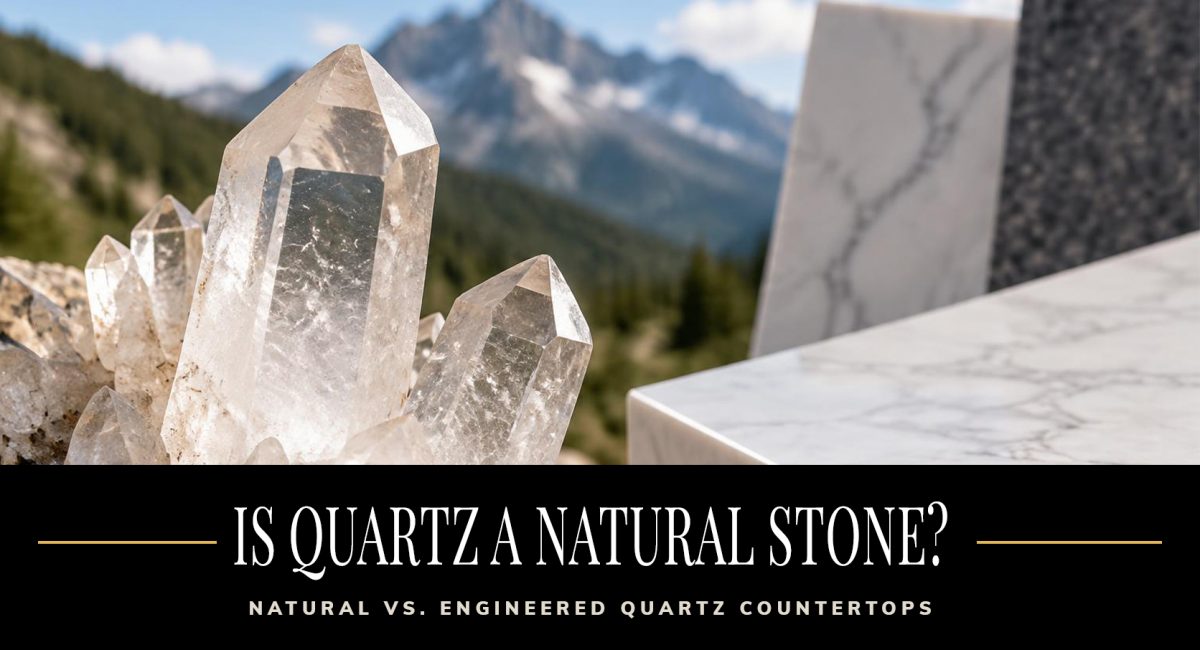
No, quartz countertops are not considered natural stone countertops. Quartz itself is a natural mineral, but the countertop in your kitchen or bathroom is an engineered surface. It is manufactured using natural quartz minerals combined with resins, pigments, and other materials that are formed into slabs.
If you want a broader look at the material before getting into what makes quartz natural or engineered, start with our [complete guide to quartz countertops].
So, if quartz countertops contain natural quartz, why aren’t they considered natural stone? The difference comes down to how the slab is made. Granite, marble, and quartzite are quarried or extracted from the earth as blocks of natural rock and cut into slabs. Quartz countertops are manufactured, which is why they are commonly called engineered quartz or engineered stone.
One thing that confuses many homeowners is the name. Quartz and quartzite sound almost the same, but they are very different materials.
Quartz countertops are engineered. Quartzite is natural stone that is quarried from the earth. If you want a clearer breakdown, our [quartz vs. quartzite countertops guide] explains the differences in more detail.
Key Takeaways
Here’s the quick version before you dive in.
- Quartz countertops are engineered (manufactured), not natural stone.
- The mineral inside is natural: about 90 percent or more of the slab is ground quartz.
- Resin binds the quartz together, and pigments add color.
- The finished surface has very low porosity, so brands like Cambria and Silestone advise against sealers.
- Natural quartz is a mineral found in rocks like granite. Quartzite is a natural stone, not the same as quartz countertops.
- Natural stone and engineered quartz are different materials: Natural stone is quarried and cut into slabs, while quartz countertops are manufactured using natural quartz minerals combined with other materials.
Engineered Quartz vs. Natural Stone at a Glance
What makes engineered quartz different from natural stone? Three things: where the material comes from, what it’s made of, and how the finished slab is formed.
| Feature | Engineered Quartz | Natural Stone |
|---|---|---|
| Classification | Engineered (manufactured) surface | Natural stone |
| Examples | Engineered quartz slabs | Granite, marble, quartzite |
| How it forms | Mixed, compacted, and cured into slabs in a factory | Forms over time through geological processes, then is quarried and cut into slabs |
| Made from | Mostly ground natural quartz (about 90% or more), plus resin and pigments | One naturally formed rock made of minerals |
| Binder | Resin holds the quartz grains together | None; the minerals bond naturally in the earth |
| Porosity | Very low | Varies by stone |
The exact composition and manufacturing process of engineered quartz vary by manufacturer and product.
At i4 Kitchen & Bath, we work with leading engineered quartz brands such as Cambria, Silestone, and Corian Quartz. Each manufacturer has its own formulations, colors, patterns, finishes, and product specifications, so our designers recommend comparing the specific product rather than assuming every quartz slab is made exactly the same way.
Is Quartz a Natural Stone?
No. Quartz countertops are not natural stone. Quartz itself is a naturally occurring mineral, but quartz countertops are engineered surfaces manufactured by combining natural quartz or other mineral materials with resin, pigments, and other ingredients. Natural stone, by contrast, forms in the earth and is quarried into slabs.
Cal/OSHA includes engineered and manufactured stone within its definition of artificial stone, which it describes as material commonly made by combining natural stone or other silica-containing materials with resins, polymers, or other binding materials.
This is where the wording can get confusing. In a quartz countertop, “quartz” refers to the mineral used in the mix, not a slab that was pulled from the earth in one solid piece.
So when you see quartz listed as an ingredient, it does not mean the countertop is a naturally formed quartz rock. It means the slab was engineered using quartz minerals, resins, pigments, and other materials.
You’ll also come across terms such as engineered quartz, engineered stone, and quartz surface when shopping for countertops. Manufacturers may use different terminology and formulations, but the basic distinction remains the same: the countertop is a manufactured surface that incorporates natural mineral material.
What Is Natural Quartz?
Natural quartz is a naturally occurring mineral composed of silicon and oxygen, with the chemical formula SiO₂. Also known chemically as silicon dioxide, quartz forms naturally in the Earth and is found in many types of rock, including granite and quartzite.
On the Mohs hardness scale, a 10-point scale that ranks minerals by their resistance to scratching, quartz defines a hardness of 7. For comparison, talc ranks at 1 and diamond at 10.
Pure quartz is clear, but tiny impurities create colors like purple amethyst, pink rose quartz, and smoky brown. Quartz also hides inside everyday rocks, including granite and sandstone. People have used quartz varieties in jewelry and carvings since ancient times, and quartz crystals even keep time inside many clocks.
That hardness is a big reason countertop makers use quartz in the first place. A mineral with a 7 rating is tough enough to handle a lot of everyday kitchen use, like keys, pans, dishes, and the normal wear that happens around a busy countertop.
For engineered quartz, natural quartz crystals are crushed into small grains and powder. Those pieces become the main ingredient used to make the finished slab.
Is Quartz a Stone?
Quartz itself is a natural mineral, not a type of rock or natural stone. However, the countertop material commonly called “quartz” is an engineered stone or manufactured surface made with natural quartz or other mineral materials combined with binders, pigments, and other ingredients.
However, the countertop material commonly called “quartz” is an engineered stone: a manufactured surface made mostly from ground natural quartz combined with resin, pigments, and other ingredients.
Here’s an easy way to keep the concepts straight:
Mineral: A naturally occurring substance with a specific chemical composition and crystal structure. Quartz is a mineral.
Rock: A naturally occurring solid made up of one or more minerals. Granite, for example, commonly contains quartz.
Natural stone: Naturally formed rock that is quarried, cut, and finished for use in homes and buildings. Granite, marble, and quartzite are examples.
Engineered stone: A manufactured material made by combining mineral materials with a binder and other ingredients. Quartz countertops are a common example.
Is Quartz Porous?
Engineered quartz is generally described as nonporous or very low in porosity, depending on the manufacturer’s terminology. Its low liquid absorption comes from the material’s engineered composition and manufacturing process, which creates a dense finished surface.
That’s another difference between engineered quartz and natural stone. The porosity of natural stone varies according to the type of stone and its individual characteristics, while engineered quartz is manufactured to create a surface with very low liquid absorption.
You may therefore see terms such as “nonporous” and “low porosity” when comparing quartz products. Check the specifications of the particular brand and surface you’re considering rather than assuming every engineered quartz product is identical.
For example, Cambria describes its quartz surfaces as nonporous and nonabsorbent, while Cosentino describes Silestone as having low or almost zero porosity.
What Are Quartz Countertops Made Of?
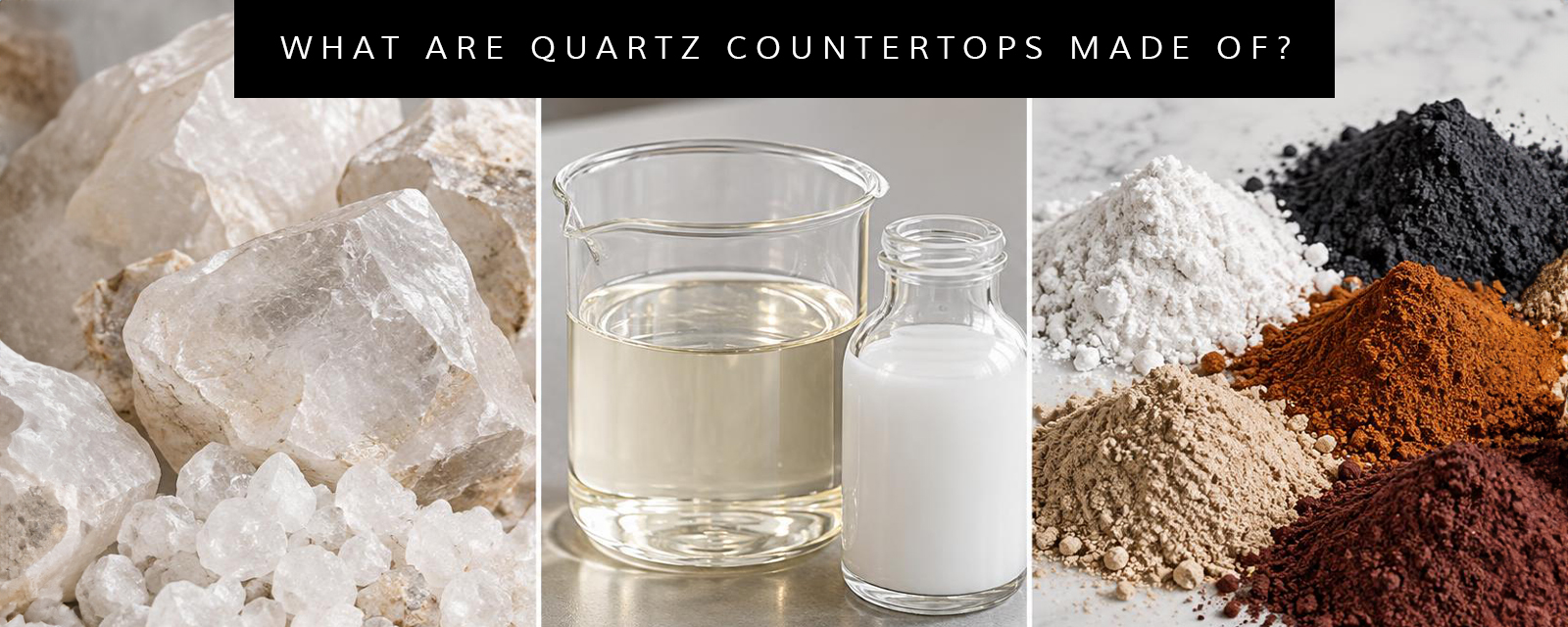
Quartz countertops are engineered surfaces made from natural quartz or other mineral aggregate combined with polymer resin, pigments, and sometimes decorative materials. Natural quartz makes up a large portion of many traditional quartz surfaces, but the exact mineral content and formulation vary by manufacturer, product line, and design.
Natural Quartz and Mineral Aggregate
Before those mineral ingredients become part of a countertop, they are processed into particles of different sizes. In manufacturing, this solid mineral portion of the mixture is often called the aggregate. In many traditional engineered quartz surfaces, natural quartz makes up a substantial portion of this mineral aggregate, although the exact mineral composition varies by manufacturer and product.
Cambria, for example, states that its surfaces contain 93 percent quartz. Other manufacturers use different formulations, which is why one brand’s percentage shouldn’t be treated as the recipe for every engineered quartz countertop.
You may also see cristobalite listed alongside quartz in technical or safety documents. Both are forms of crystalline silica, and their amounts can vary by product.
Resins and Binders
Resin is what helps turn loose mineral particles into a solid countertop slab. Engineered quartz manufacturers commonly use polymer binders, although the exact type and amount vary by manufacturer and product.
But resin isn’t always working alone. Some engineered quartz formulations also contain silane coupling agents, additives used in small amounts to improve the bond between the mineral particles and the resin. Think of silane as helping these two very different materials work together more effectively.
Once the mineral aggregate, resin, pigments, and other additives are mixed, the material is compacted and cured to form a solid slab. The binder represents only one part of the formulation, but it plays an essential role in holding the engineered surface together.
Pigments and Decorative Materials
Pigments are what give engineered quartz its color. They help create the background shade, whether that is bright white, soft gray, warm beige, deep black, or something bolder.
Some quartz designs go beyond color alone. Manufacturers may add recycled glass, tiny metallic flecks, or other decorative materials to give the slab more depth, shimmer, or texture.
That is how you get such a wide range of looks, from soft, marble-inspired quartz to bold designs that are meant to stand out.
Pigments may be mineral-based or synthetic, depending on the formulation. Titanium dioxide, for example, is used to create or brighten lighter colors and appears in Cambria’s safety data sheet at less than 5 percent by weight.
Some quartz designs include more than pigments. For example, certain Cambria products use small amounts of metals, like copper or nickel, to create metallic effects. Corian Quartz, formerly known as Zodiaq, has also offered designs with recycled glass.
The key thing to know is that these ingredients are not the same in every quartz countertop. They change by brand, collection, and design. That is why it is better to look at the specs for the exact product you are considering instead of assuming every engineered quartz slab is made with the same decorative materials.
Are Quartz Countertops 100% Quartz?
No, quartz countertops are not 100 percent quartz. Traditional engineered quartz surfaces are commonly made with about 90% to 95% or more mineral material by weight, combined with 5% to 10% resin, pigments, and sometimes other ingredients. Exact formulations vary by manufacturer and product, so not every quartz countertop has the same percentage of quartz.
Manufacturer specifications show why a quartz countertop should not be assumed to be 100 percent quartz. Cambria states that its surfaces contain 93 percent quartz, with pigments and binders making up the rest. Silestone uses a different formulation. Cosentino says its current Silestone surfaces use Hybriq+ technology with reduced crystalline silica content, and Silestone XM contains a maximum of 10 percent crystalline silica along with other mineral materials, recycled materials, resin, pigments, and additives. The exact composition therefore depends on the manufacturer and product.
It also helps to read quartz marketing language carefully. When a product description says something like “pure natural quartz,” it may be talking about the quartz mineral used in the mix, not the finished slab as a whole.
The countertop itself is still engineered. Technical documents usually separate the quartz, resin, pigments, and other ingredients, which gives you a clearer picture of what the slab is actually made from.
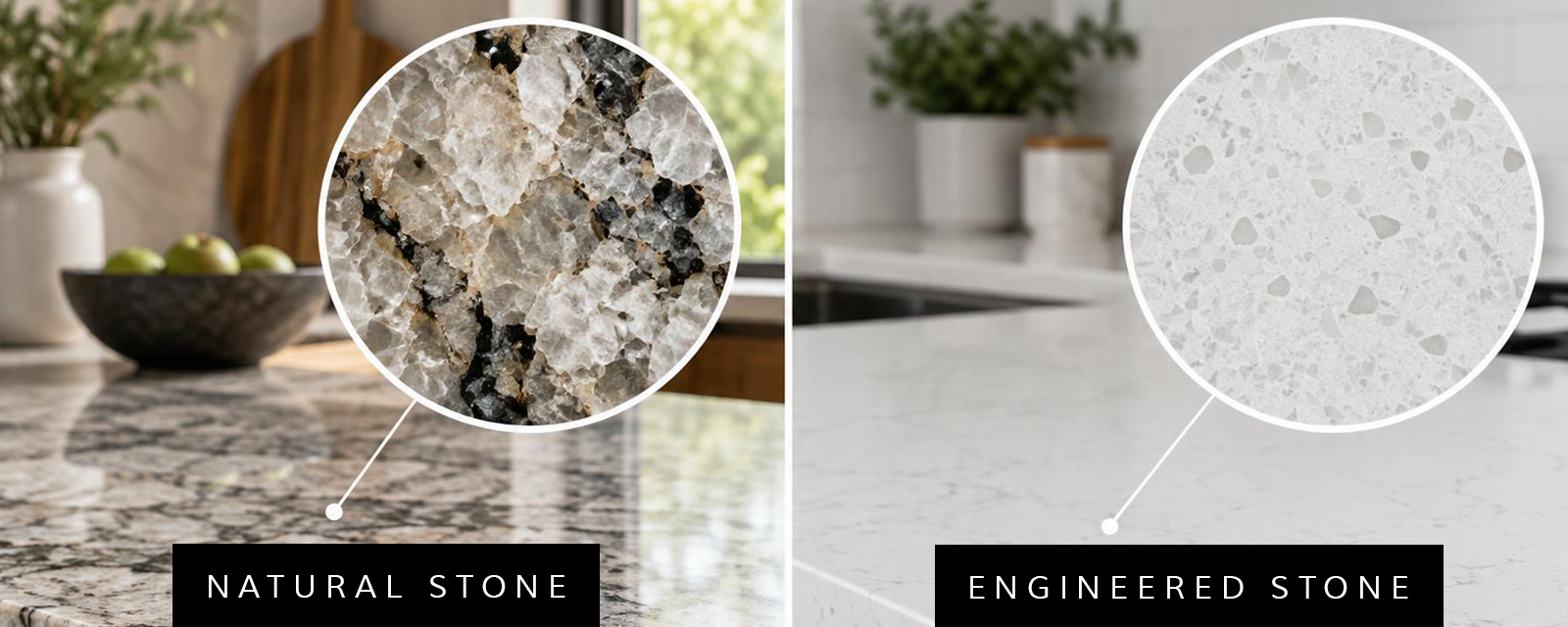
Engineered Stone
The word “engineered” does a lot of work in this industry, and it’s worth pinning down exactly what it means and whether it changes what you’re really getting.
What is Engineered Stone?
Engineered stone is a manufactured composite surface made by combining mineral materials with resins or other binders, pigments, and sometimes additional ingredients. Unlike natural stone, which forms through geological processes, engineered stone is produced using a controlled formulation and manufacturing process.
“Engineered” describes a deliberate design process, not just a manufacturing method. Producers control the mix of quartz, resin, and pigments specifically to build in the traits homeowners want: a harder, less porous surface than many natural stones, and a color and pattern that repeats reliably from slab to slab. Natural stone can’t be engineered this way, since its properties are set by geology, not a formula.
The word also applies beyond quartz. Engineered stone is a broader category that includes engineered marble and similar composite products, built the same way but starting from a different crushed mineral. Quartz is simply the version most commonly sold for countertops today.
Is Engineered Quartz Still “Real” Quartz?
Yes, but there is an important distinction. The mineral quartz used in these countertops is natural, while the countertop itself is a manufactured surface created by combining mineral ingredients with binders, pigments, and other materials. In other words, the quartz is real, but the slab is engineered.
Manufacturers themselves reflect this dual identity in their own paperwork. Cambria’s current safety data sheet, for example, lists “Natural Quartz Slabs” and “Natural Quartz Surface” as official synonyms for its product, alongside “Engineered Stone.” Both descriptions are accurate. One describes the ingredient; the other describes how it became a countertop.
How Are Quartz Countertops Made?
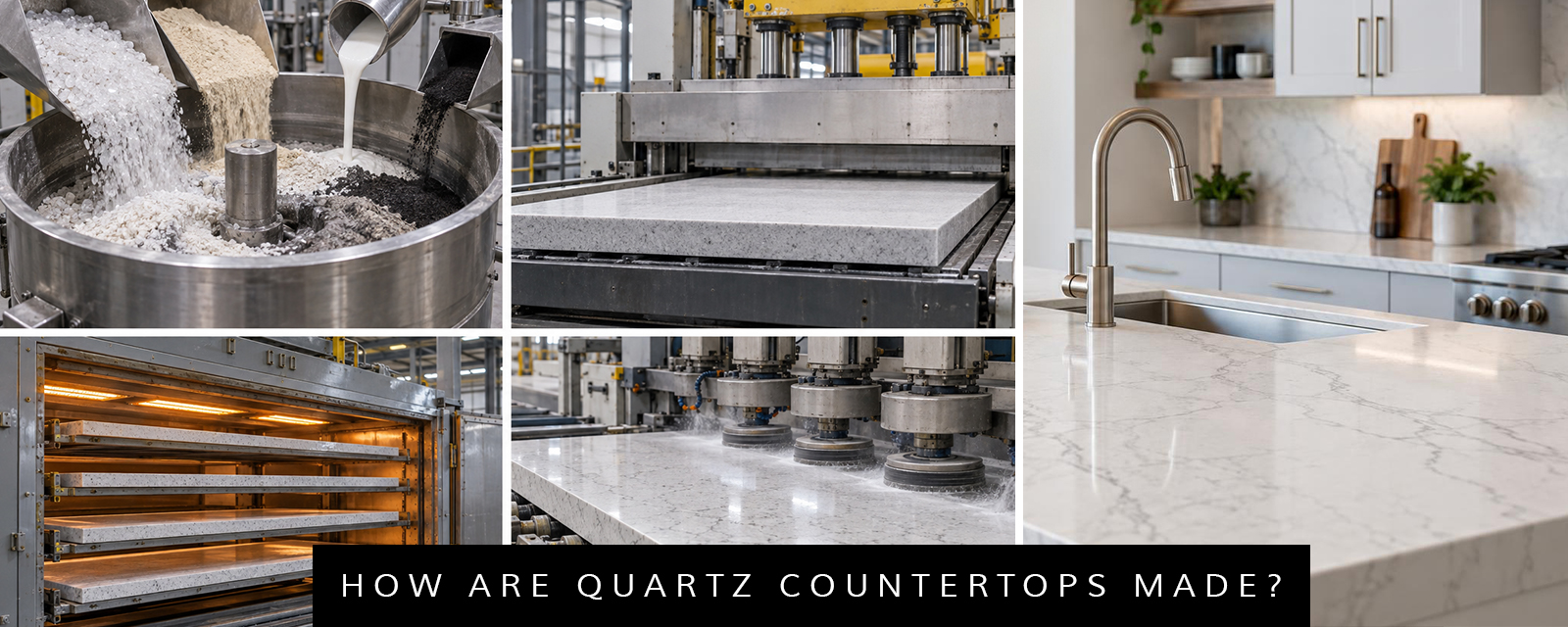
Quartz countertops are made by crushing natural quartz into small grains, mixing it with resin, pigments, and sometimes other additives, then compacting that mixture under vacuum and vibration to remove air pockets. The compacted slab is cured with heat to harden the resin, then cut, polished, and finished.
1. Quartz and Other Raw Materials Are Prepared
Manufacturing starts with the quartz itself. Quartz is mined, then crushed and ground down into an aggregate, ranging from a fine powder to a coarser mix, depending on the look a manufacturer wants. Finer grinding tends to produce a more solid, uniform color, while coarser pieces create more of a speckled texture, which is one reason two quartz colors can look so different even though both are mostly the same mineral.
While the quartz is being prepared, the other ingredients are measured out separately: the resin binder, pigments for color, and any decorative additives like metal flecks or recycled glass, in whatever proportions that manufacturer’s formula calls for.
2. Minerals, Binders and Pigments Are Mixed
Once the raw materials are ready, they’re combined in a mixer until the blend is uniform throughout. How thoroughly, and how evenly, the ingredients are mixed has a direct effect on the finished pattern. A well-blended, uniform mix produces a solid color. Layering or folding the mix less evenly is part of how manufacturers create veining and speckled patterns that echo natural stone.
Small amounts of additives, including the silane compounds covered earlier in this guide, are typically added at this stage too. Their job is to help the resin bond tightly to each quartz grain during mixing, rather than just settling around it.
3. The Mixture Is Compacted Into Slabs
The mixed material is poured into a mold and then compacted using a combination of vibration and vacuum pressure, a method sometimes called vibrocompression. The technique was developed in Italy by Breton S.p.A. and is now used by most major quartz manufacturers, including Cambria and Silestone, among others. The vacuum removes trapped air as the vibration settles and compresses the mixture, closing up the tiny gaps that would otherwise make the slab porous.
The result is a solid, dense slab, though it still needs heat to fully harden before it can be cut and polished.
4. The Slabs Are Cured
Heat is what finishes the chemical transformation. The compacted slab goes through a curing process in large ovens, where heat triggers a reaction in the resin that hardens it permanently and locks the quartz grains in place. Before curing, the slab is still somewhat workable. Afterward, it’s a solid, rigid surface that won’t soften again under normal kitchen conditions.
5. The Slabs Are Finished
Once cured and cooled, slabs are calibrated to a consistent thickness, commonly 2 cm or 3 cm, then cut to standard slab dimensions. From there, the surface gets its finish: polished for high gloss, or honed and textured for a matte look, depending on the collection. Each slab is inspected for quality before it ships out to fabricators, who cut and install it as an actual countertop in someone’s kitchen.
Is Quartz a Good Countertop Material?
For many kitchens, yes. Engineered quartz combines a dense, low-maintenance surface with a broad range of designs, which helps explain why it has become such a widely used countertop material.
A lot of what people like about quartz comes from the way it is made. The quartz minerals, resin, pigments, and other ingredients are blended together, pressed tightly, and cured into a dense surface.
That is different from natural stone, where the look and performance come from how the stone formed in the earth. With engineered quartz, the process is controlled from the start, which helps create a more consistent slab in color, pattern, and everyday performance.
That doesn’t mean quartz is the right choice for every kitchen. Heat sensitivity, outdoor limitations for many products, and other practical considerations still matter.
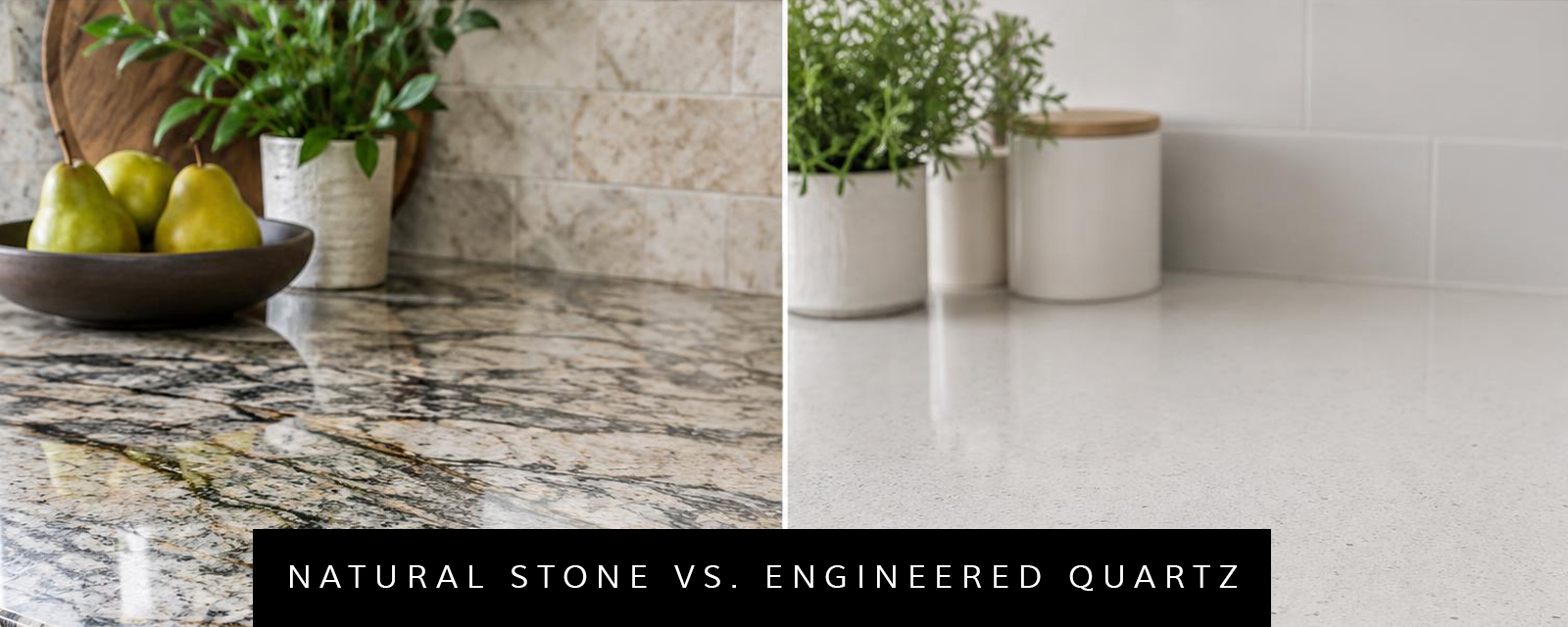
How to Decide Between Natural Stone and Engineered Quartz
Natural stone and engineered quartz can both make a beautiful kitchen, and the better choice usually comes down to two practical questions: how you use your kitchen or the look you want, rather than one material being objectively better than the other.
Choose Based on How You Use Your Kitchen
Because quartz is engineered, a manufacturer can choose what traits to prioritize in its formula, and different brands make different choices. That means “quartz” isn’t one uniform performer. Before assuming a countertop will hold up to your specific habits,ask what that particular manufacturer’s product is rated for, rather than treating all quartz as identical.
Natural stone is different. Its characteristics begin with geology rather than a manufactured formula, so properties can vary by stone type and even from one slab to another. That distinction matters when you’re comparing materials: with engineered quartz, you’re evaluating a manufactured product; with natural stone, you’re also evaluating the characteristics of the particular stone.
Choose Based on the Look You Want
This is where the natural-versus-engineered divide is most absolute. Natural stone gets its color, veining, mineral deposits, and other characteristics from geological processes. That means each slab has naturally occurring variation that wasn’t designed or manufactured.
Engineered quartz approaches appearance differently. Its colors and patterns are intentionally created during manufacturing, giving producers greater control over the finished design and generally more predictability from one piece to another.
So, ask yourself what appeals to you more. Do you love the natural variation of an individual stone slab, or would you rather have the greater design predictability of an engineered surface?
Choose Based on the Maintenance You’re Comfortable With
The same compacting process covered earlier in this guide, removing air pockets under vacuum and vibration, is exactly why quartz typically doesn’t need sealing. Low maintenance isn’t an accident; it’s an engineered outcome, built into the material during manufacturing rather than achieved afterward.
Natural stone’s maintenance needs come from its geology and can’t be engineered away. Most granite doesn’t need yearly sealing, contrary to popular belief, but porosity still varies by slab and by stone type, since nothing is designed to be consistent. If you want maintenance you can predict in advance, that predictability is a direct result of the manufacturing process, not a coincidence.
See the Full Slab or Sample Before Deciding
Engineered quartz offers greater design consistency than natural stone, but keep the scale of the design in mind when evaluating a sample. A small sample can help you understand the background color and finish, but it may not show how large veins or patterns move across an entire countertop.
Natural stone requires a different approach. Because its veining, mineral deposits, and color variation formed naturally, one section of a slab may look quite different from another. When possible, seeing the specific slab selected for your project can give you a better understanding of how that natural variation will appear in your space.
Also consider how the countertop works with your cabinetry, flooring, backsplash, and lighting. A material that looks one way on its own can feel very different once it becomes part of the complete kitchen design.
Is Quartz a Natural Stone FAQs
Quick answers to the questions people ask most about quartz and where it comes from.
Is quartz natural or man-made?
Man-made. The quartz mineral itself is natural, but the countertop is manufactured: ground quartz bound with resin in a factory. Some marketing calls it “natural quartz,” which describes the main ingredient, not the finished product. The finished slab is classified as engineered stone, not natural stone.
Is quartz real stone?
It contains real quartz, a genuine mineral mined from the earth, but the countertop itself isn’t a solid piece of quarried stone the way a granite countertop is. It’s a manufactured composite, mostly quartz by weight, bound with resin. Real ingredient, manufactured product.
Are quartz countertops made from natural quartz?
Yes. Quartz countertops are made mostly from natural quartz, generally about 90 percent or more, ground down and combined with resin and pigments. The quartz itself comes from the earth. Only the finished slab, not the mineral inside it, is manufactured.
What is the difference between quartz and engineered quartz?
There isn’t a difference when it comes to countertops: “quartz” and “engineered quartz” describe the exact same product. The confusion usually comes from the word “quartz” also referring to the raw mineral, or getting mixed up with quartzite, a natural stone with a similar-sounding name but a very different origin.
Is quartz the same as quartzite?
No. Quartzite is a natural stone, a metamorphic rock formed from sandstone under heat and pressure, and it’s quarried and cut like granite. Quartz countertops are engineered in a factory from crushed quartz and resin. The names sound alike, so it’s worth confirming which one is on any quote.
Is quartz good for kitchen countertops?
For most kitchens, yes. Beyond its low upkeep and stain resistance, quartz has a kitchen-specific advantage: Cambria’s quartz carries NSF/ANSI 51 certification for food-contact areas, the same standard used for commercial food equipment. Its main limits, heat sensitivity and indoor-only use, are worth knowing before you buy.
Does quartz need to be sealed?
Typically not. Manufacturers including Cambria and Silestone say their quartz doesn’t need sealing, and both advise against applying sealers at all. That’s a real difference from many natural stones, where sealing needs vary by stone type. Mild soap and water handle most everyday cleaning.
Conclusion
The word “quartz” can be confusing because it refers to two things: the natural mineral and the engineered countertop made mostly from that mineral.
Once you understand that difference, the rest starts to make more sense. Quartz is not the same as quartzite. It does not need sealing like many natural stones. And yes, it is a real countertop material, just a manufactured one.
That gives you a better way to read product labels, listen to sales claims, and ask the right questions before choosing a slab.
Upgrade Cabinets & Counters With Confidence
Discover premium finishes and high-end materials in Orlando & Central Florida. Visit our showroom or schedule a free consultation by calling (407) 246-0636 or filling out a contact form.
References
- California Division of Occupational Safety and Health (Cal/OSHA), Engineered Stone Countertop Fabrication: https://dir.ca.gov/dosh/dosh_publications/Engineered-stone-counters.pdf
- Cambria, Product Care FAQs: https://www.cambriausa.com/faq/care/
- Cambria, Product Specification Sheet: https://www.cambriausa.com/content/dam/cusa/sales-marketing-collateral/product-technical-information/product-specification-sheet-english.pdf
- Cambria, Quartz FAQs (composition, NSF/ANSI 51, seams): https://www.cambriausa.com/content/dam/cusa/sales-marketing-collateral/home-depot/home-depot-quartz-faqs-sell-sheet.pdf
- Cambria, Safety Data Sheet: https://www.cambriausa.com/content/dam/cusa/sales-marketing-collateral/product-technical-information/cambria-safety-data-sheet.pdf
- Cambria, Thicknesses and Edge Profiles: https://www.cambriausa.com/quartz-countertops/thicknesses-edge-profiles
- Cosentino USA, Silestone Maintenance: https://www.cosentino.com/usa/silestone/maintenance/
- Cosentino, Silestone Safety Data Sheet: https://osh.cosentino.com/wp-content/uploads/2023/05/Safety-Datasheet-Silestone-2023-13_04-2023-EN-Digital.pdf
- Cosentino USA, Silestone Cladding: https://www.cosentino.com/usa/silestone/cladding/
- DuPont, Corian Quartz: https://www.corianquartz.com/
- U.S. EPA CompTox Chemicals Dashboard, Corian Solid Surface: https://comptox.epa.gov/chemexpo/product/582431/
- Natural Stone Institute, Sealing Natural Stone Countertops: https://www.naturalstoneinstitute.org/consumers/sealing-stone/
- Natural Stone Institute, What Is Sandstone and Quartzite: https://www.naturalstoneinstitute.org/consumers/varieties/sandstone/