Thickness is one of the few countertop details you can’t change once the slab is cut. It shapes how your counter looks at the edge, how much it weighs, and how it’s supported underneath. So which one fits your kitchenor bath? Still deciding whether quartz is the right material for you? Start with our complete guide to quartz countertops. Wondering how big the full slab is, or what size you need? See Quartz Slab Sizes: Standard, Jumbo, and Super Jumbo Dimensions.
Key Takeaways
Short on time? Here’s the quick version.
- Quartz countertops come in 2 cm (about 3/4 inch) or 3 cm (about 1 1/4 inches).
- Thinner quartz slabs come in1 to 1.2 cm and are mostly used for vertical surfaces.
- Quartz weighs roughly 9 to 10 pounds per square foot at 2 cm and 13.5 to 15 pounds at 3 cm
- Support needsdepend on overhang, cutouts, and span, so ask how your countertop will be supported.
- A fabricator can give your countertop a thicker, more substantial look by building up the front edge with extra quartz or by joining mitered pieces at an angle. Either method creates the appearance of a thicker slab without adding that thickness across the entire countertop.
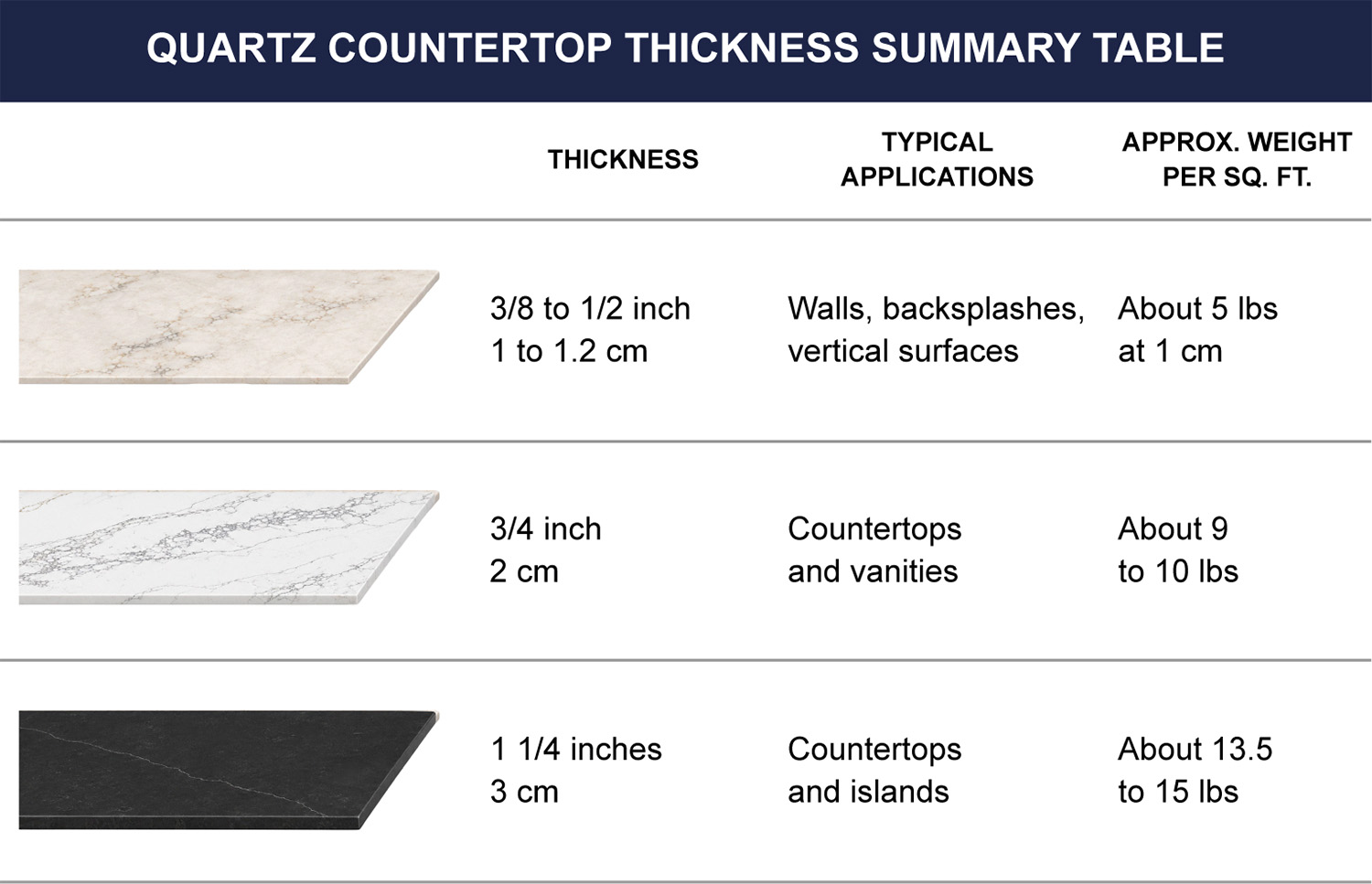
Quartz Countertop Thickness Summary table
Here’s quartz thickness at a glance.
| Thickness | Approx. inch thickness | Typical applications | Approx. weight per square foot |
|---|---|---|---|
| 1 to 1.2 cm | 3/8 to 1/2 inch | Walls, backsplashes, vertical surfaces | About 5 lbs at 1 cm |
| 2 cm | 3/4 inch | Countertops and vanities | About 9 to 10 lbs |
| 3 cm | 1 1/4 inches | Countertops and islands | About 13.5 to 15 lbs |
Note: Thickness availability varies by manufacturer, color, and collection. At i4 Kitchen & Bath, we work with leading engineered quartz brands such as Cambria, Silestone, and Corian Quartz.
Quartz Thickness Explained
When choosing a thickness for a quartz countertop, keep in mind that thickness affects weight, the support a top needs, and how the edge looks.
How Thick Are Quartz Countertops?
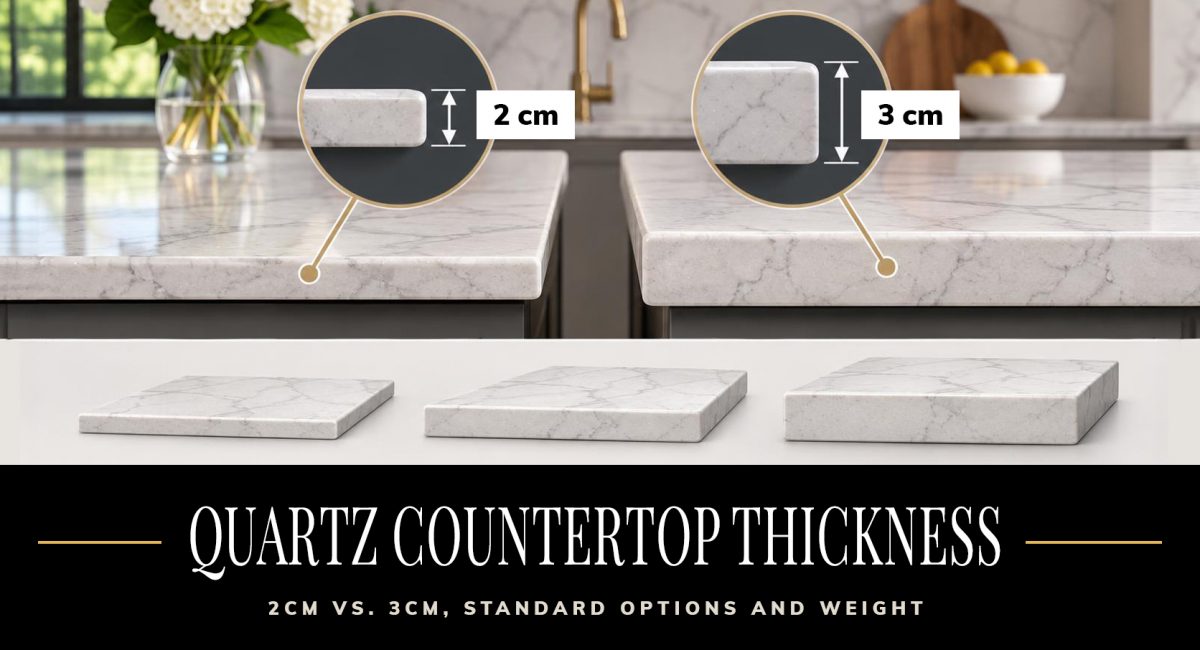
Most quartz countertops are 2 cm or 3 cm thick, about 3/4 inch and 1 1/4 inches. Exact thickness can vary slightly by manufacturer.
Quartz Countertops Thickness in Centimeters, Millimeters and Inches
|
CENTIMETERS |
MILLIMETERS |
INCHES (ACTUAL) |
TRADE NAME |
|---|---|---|---|
|
1 cm |
10 millimeters |
0.39 inch |
3/8 inch |
|
1.2 cm |
12 millimeters |
0.47 inch |
1/2 inch |
|
2 cm |
20 millimeters |
0.79 inch |
3/4 inch |
|
3 cm |
30 millimeters |
1.18 inches |
1 1/4 inches |
How Thick Is Quartz? Nominal vs. Actual Thickness
Nominal thickness is the name a slab is sold by, and actual thickness is what you would measure. A 2 cm slab is about 0.79 inches, slightly over its 3/4 inch name, and a 3 cm slab is about 1.18 inches, slightly under its 1 1/4 inch name.
Small manufacturing variation adds to the gap: Manufacturers note that minor variations in size and thickness are inherent to the process. When a precise fit matters, such as at a dishwasher or an existing backsplash, measure the actual slab.
Standard and Typical Quartz Countertop Thickness
The standard thicknesses for quartz countertops are 2 cm and 3 cm. Manufacturers such as Cambria say both are made for countertops and must be supported, and that its thin 1 cm slabs are mainly for walls and other vertical surfaces. Which countertop thickness you choose depends on your layout, your overhang, and the look you want.
Availability varies by design and color. Cambria, for example, offers 1 cm only in select designs. Check that your color comes in the thickness you want.
How Thick Is 3cm Quartz?
A 3 cm quartz slab is approximately 1.18 inches thick, and it is sold as a 1 1/4 inch countertop, so the actual slab is slightly thinner than the name suggests. That 3 cm shows at the edge, so even a simple edge reads as a substantial profile.
How Thick Is 2cm Quartz?
A 2 cm quartz slab is approximately 0.79 inches thick and is commonly referred to as 3/4-inch quartz.
Its slimmer profile can give a kitchen or bathroom a lighter, more contemporary look, and the slab weighs less than 3 cm quartz. However, because it is thinner, 2 cm quartz may need additional support around overhangs, cutouts, and wider spans, depending on the layout and installation requirements.
If you like the look of a thicker countertop, the front edge can still be built up or mitered without increasing the thickness of the entire slab.
The tradeoff is cost. Special edge fabrication requires more cutting, fitting, and finishing, so a 2 cm slab with a thick built-up or mitered edge is not automatically cheaper than 3 cm quartz. Compare the complete installed price, not just the slab cost.
Quartz Countertop Thickness Options
Quartz countertops are most commonly available in 2 cm (about 3/4 inch) and 3 cm (about 1 1/4 inches). Some manufacturers also offer thinner 1 to 1.2 cm slabs, often used for walls, backsplashes, and other vertical surfaces. Available thicknesses vary by manufacturer, color, and collection.
|
Thickness |
Approx. inch thickness |
Where it’s used |
Availability examples |
|---|---|---|---|
|
1 to 1.2 cm |
3/8 to 1/2 inch |
Walls, backsplashes, shower surrounds |
Cambria offers 1 cm in select designs, and Silestone and Vicostone list 1.2 cm |
|
2 cm |
3/4 inch |
Countertops and vanities |
Cambria, Caesarstone, Silestone, Corian Quartz, and Vicostone |
|
3 cm |
1 1/4 inches |
Countertops and islands |
Cambria, Caesarstone, Silestone, Corian Quartz, and Vicostone |
2cm vs. 3cm Quartz Countertop Thickness
The main difference between 2 cm and 3 cm quartz is thickness, weight, support, and appearance. A 3 cm slab is thicker, heavier, and usually needs less additional support, while 2 cm quartz is lighter and creates a slimmer, more modern look.
Strength and Durability
Both 2 cm and 3 cm quartz are made from the same type of material, so thickness does not change the basic stain resistance or maintenance of the surface. Cambria, for example, states that both thicknesses offer the same durability and performance.
The main difference comes down to how much support each thickness needs. Because 2 cm quartz is thinner, it can flex more, especially around sink cutouts, long spans, and overhangs. With the right support, though, it can still make a very durable countertop.
A 3 cm slab is thicker and sturdier, which means it can often span wider areas or extend farther beyond the cabinets without extra support. The exact limits depend on your kitchen layout and the manufacturer’s installation guidelines.
Slab Thickness vs. Edge Thickness
Slab thickness is the thickness of the quartz itself. Edge thickness is how thick the finished countertop looks from the front. The two are not always the same.
A fabricator can use a 2 cm or 3 cm slab and make the front edge look thicker by adding extra quartz or creating a mitered edge. With a mitered edge, separate pieces are cut at an angle and joined so the countertop appears thicker than the slab itself.
This gives you more design flexibility. You can keep the countertop lighter while still creating a bold, substantial edge. Some decorative edge profiles also require a thicker built-up edge, while simpler profiles, such as eased edges, can work with thinner slabs.
Cambria, for example, offers built-up edge depths of 4 cm and 6 cm, about 1.57 and 2.36 inches.
Is Thicker Quartz More Expensive?
Yes, 3 cm quartz is generally more expensive than 2 cm quartz because it uses more material and is heavier to transport and handle. However, the final installed cost also depends on fabrication, edge details, support requirements, and the fabricator’s pricing.
A thinner 2 cm slab may cost less upfront, but it can require additional support or more complex edge fabrication. That can reduce some of the savings.
Edge work is a cost factor too: Cambria notes that elaborate edges such as ogee or waterfall can increase costs, while an eased edge is a budget-friendly choice. A 2 cm top with a mitered edge or a full plywood base also adds fabrication and installation labor, so compare the whole installed price. For what drives the total, see How Much Do Quartz Countertops Cost?
Does 2cm Quartz Need Extra Support?
Yes, 2 cm quartz often needs more support than 3 cm quartz, especially around overhangs, wide cabinet spans, sinks, and other cutouts. The exact amount depends on your countertop layout and the installation requirements for the quartz you choose.
An overhang is the part of the countertop that extends past the cabinets, such as the seating side of a kitchen island. The farther quartz extends without cabinets underneath it, the more likely it is to need brackets, steel supports, legs, or another supporting structure. Published limits vary by brand. Cambria calls for added support past 12 inches at 2 cm and 15 inches at 3 cm, some brands set lower limits, and Cosentino, the maker of Silestone, allows longer overhangs in its current manual when at least twice the overhang depth rests on the cabinets. Confirm the limit for your exact product.
|
Situation |
2 cm quartz |
3 cm quartz |
|---|---|---|
|
Small overhang |
Cambria calls for support past about 12 inches; some brands set lower limits |
Cambria calls for support past about 15 inches; limits vary by brand |
|
Larger seating overhang |
Usually needs brackets or another structural support |
Can generally extend farther before support is needed |
|
Very large overhang |
May need a continuous support structure plus legs, panels, or posts |
May also need structural support, but usually at a greater overhang depth |
|
Wide spans between cabinets |
May need blocking or a supporting sub-top |
More rigid, but still needs properly spaced cabinet support |
|
Sink or cooktop area |
Needs careful support around the opening |
Also requires proper support around openings |
Does 2cm Quartz Need Plywood Underneath?
Sometimes, but not every installation follows the same rule. Plywood is a strong, flat wood panel that can sit on top of the cabinets underneath the quartz, creating a continuous support surface for the countertop.
Some 2 cm quartz installations use this hidden support board, or another approved sub-top, to give the thinner slab more rigidity. Other systems allow 2 cm quartz to sit directly on properly spaced cabinet supports, as long as the countertop and overhang stay within the manufacturer’s limits.
The important question is not simply, “Does it need plywood?” At i4 Kitchen & Bath, we look at your countertop layout, overhangs, cabinet support, and selected quartz to determine what type of support your installation needs.
2cm vs. 3cm Quartz Comparison Table
Here’s how 2 cm and 3 cm quartz compare side by side. In short, 3 cm is thicker, heavier, and reaches farther before it needs support, while 2 cm is lighter and slimmer. Both are suitable for countertops, and both need proper support.
| Factor | 2 cm | 3 cm |
|---|---|---|
| Actual thickness | 0.79 inches | 1.18 inches |
| Common U.S. size | 3/4 inch | 1 1/4 inches |
| Approx. weight per square foot | 9 to 10 pounds | 13.5 to 15 pounds |
| Unsupported overhang | About 12 inches for Cambria; varies by brand | About 15 inches for Cambria; varies by brand |
| Edge with no build-up | Slimmer | More substantial |
| Common uses | Countertops and vanities | Countertops and islands |
Standard Quartz Sink Top Thickness
The standard thickness for a quartz sink top is 2 cm (about 3/4 inch), or 3 cm (about 1 1/4 inches). The sink area does not usually require a thicker slab, but the quartz around the cutout needs proper support to protect the countertop and safely hold the sink.
- Support around the sink: The quartz around the cutout needs support underneath, especially along narrow sections of stone.
- Space around cutouts: Sink openings should not be placed too close to countertop edges or seams because those areas can be more vulnerable to stress.
- Undermount sinks: The sink must be mechanically supported from underneath. Adhesive alone should not carry the weight of the sink.
- Large or heavy sinks: Additional support bars or a sink-support system may be needed so the weight transfers to the cabinets instead of the quartz.
- Rounded cutout corners: Slightly rounded inside corners help reduce concentrated stress around the sink opening.
Exact clearances and support requirements vary by quartz manufacturer and countertop layout. At i4 Kitchen & Bath, we account for the sink size, cabinet structure, slab thickness, and surrounding countertop when planning the installation.
Quartz Slab Weight: How Much Do Quartz Countertops Weigh?
Quartz countertops are heavy, and their total weight depends on the slab’s thickness and surface area. A full quartz slab can weigh approximately 415 to 1,200 pounds, depending on its dimensions and thickness. That weight matters when planning transportation, installation, cabinet support, and the structure beneath very large kitchen islands.
How Much Does a Quartz Countertop Weigh Per Square Foot?
Quartz countertops weigh about 9 to 10 pounds per square foot at 2 cm thick and about 13.5 to 15 pounds per square foot at 3 cm thick. A 3 cm countertop is about 50 percent thicker, so it also weighs roughly 50 percent more than a 2 cm countertop of the same size.
To estimate the weight of your countertop, multiply its square footage by the weight per square foot.
|
Countertop area |
Weight at 2 cm |
Weight at 3 cm |
|---|---|---|
|
10 square feet |
90 to 100 pounds |
135 to 150 pounds |
|
30 square feet |
270 to 300 pounds |
405 to 450 pounds |
|
50 square feet |
450 to 500 pounds |
675 to 750 pounds |
Actual weight varies slightly by manufacturer and product. Cambria lists approximately 10 pounds per square foot for 2 cm quartz and 15 pounds for 3 cm, while Caesarstone publishes similar ranges.
Quartz Slab Weight by Thickness (Full Slab)
A full quartz slab typically weighs about 415 to 705 pounds in a standard size and about 495 to 900 pounds in a jumbo size, depending on the slab’s thickness and dimensions. Super jumbo slabs can weigh roughly 675 to 1,200 pounds.
| Slab size | Typical area | Weight at 2 cm | Weight at 3 cm |
|---|---|---|---|
| Standard | 46 to 47 square feet | About 415 to 470 pounds | About 620 to 705 pounds |
| Jumbo | 55 to 60 square feet | About 495 to 600 pounds | About 740 to 900 pounds |
| Super jumbo | 75 to 80 square feet | About 675 to 800 pounds | About 1,010 to 1,200 pounds |
Actual weight varies by manufacturer and slab dimensions. For example, Caesarstone lists standard slab weights of 417 to 463 pounds at 2 cm and 639 to 675 pounds at 3 cm. Its jumbo slabs weigh approximately 520 to 575 pounds at 2 cm and 798 to 842 pounds at 3 cm.
Because a full slab can weigh several hundred pounds, transportation and installation require professional handling and appropriate lifting equipment.
Cabinet and Floor Support for Heavy Quartz
Most cabinets in good condition can handle the weight of quartz countertops, as long as they are level, sturdy, and properly secured. But if your cabinets are older, starting to sag, or have water damage, they may need some attention before the new countertop goes in. It is worth checking them early, especially if you plan to keep your existing cabinets.
A few areas are worth checking before installation:
- Flat and level cabinets: Quartz needs a solid, even surface underneath. If the cabinets are uneven or starting to sag, they can put extra stress on the slab and increase the chance of cracks.
- Long spans and cutouts: Sinks, cooktops, seams, and wide cabinet openings can leave parts of the countertop with less support. Your fabricator may need to reinforce those areas.
- Large overhangs: Planning an island with seating? If the countertop extends too far beyond the cabinets, it may need brackets, steel supports, or additional framing to keep it secure.
- Very large islands: A big quartz island can weigh several hundred pounds, and that is before counting the cabinets, appliances, and everything stored inside. All that weight needs to be properly supported.
- Floor structure: Most homes can handle a typical quartz countertop without any special changes. But if you are planning an oversized island, working with an older home, or remodeling an upstairs kitchen, it is worth having the floor structure checked before installation.
Quartz Thickness by Space: Kitchens, Vanities and Backsplashes
The right quartz thickness changes with the job the surface needs to do. Kitchen counters and islands need enough rigidity for spans, cutouts, and seating overhangs, bathroom vanities balance structure with visual proportion, and backsplashes can often use thinner material because the quartz is supported vertically against the wall.
Quartz Kitchen Countertops Thickness
Quartz kitchen countertops are commonly available in 2 cm and 3 cm thicknesses, and both work well for kitchen use. Choose 3 cm for a thicker, more substantial look and greater rigidity, or 2 cm for a slimmer, lighter appearance.
For example, some kitchens use 2 cm quartz on the perimeter and a thicker-looking island to create contrast and make the island stand out as a focal point.
Quartz Bathroom Vanity Countertop Thickness
Quartz bathroom vanity tops are also commonly available in 2 cm and 3 cm thicknesses. A 2 cm top creates a slimmer, lighter look, while 3 cm gives the vanity a more substantial appearance.
For example, a thicker vanity top can help anchor the design and make the countertop feel more prominent, especially in a larger bathroom or on a statement vanity.
Quartz Backsplash Thickness
Quartz backsplashes are commonly 2 cm or 3 cm thick. Some manufacturers also offer thinner 1 to 1.2 cm slabs for wall applications, which create a slimmer profile and sit closer to the wall.
A backsplash can match the countertop thickness for a more substantial, coordinated look, or use a thinner slab for a lighter appearance, especially on a full-height backsplash.
• Outlets and switches: Quartz adds thickness to the wall, so electrical outlets and switch boxes may need extensions or adjustments. This should be planned before the backsplash is fabricated and installed.
1 cm Quartz Slabs: Where They Work (and Where They Don’t)
A 1 cm quartz slab, about 3/8 inch thick, is best suited for vertical surfaces such as walls, backsplashes, shower surrounds, and other decorative applications. It can be used horizontally only with support underneath, which is why it is not the usual choice for kitchen countertops or islands.
- Where it works best: Thin quartz is a good choice for walls, backsplashes, and shower surrounds. These surfaces do not have to support the same weight and pressure as a countertop.
- Where it needs extra support: Thinking about using thin quartz for a bathroom vanity? It can work, but it usually needs a solid, continuous base underneath. Your fabricator should also follow the manufacturer’s installation guidelines.
- Where it is less practical: For kitchen islands, long countertop runs, or large overhangs, thicker quartz is usually the better option. It provides more rigidity and can reduce the need for additional support.
- Availability: You will not find thin quartz in every color or collection. Cambria offers some designs in 1 cm, while Silestone and Vicostone have 1.2 cm options.
Pros: Thin quartz is lighter and gives you that slim, modern look. It is especially attractive for full-height backsplashes and walls where you want a clean finish without a thick edge.
Cons: It is not as rigid as 2 cm or 3 cm quartz, so horizontal installations need more support. You will also have fewer colors and designs to choose from.
How to Choose the Right Quartz Thickness
Choosing the right quartz thickness starts with your countertop layout, the support it needs, and the look you want to achieve. Consider where the quartz will be installed, the size of any overhangs or cutouts, and your preferred edge style. Your fabricator can help you determine which thickness best fits your design and installation requirements.
When to Choose 3cm Quartz Countertops
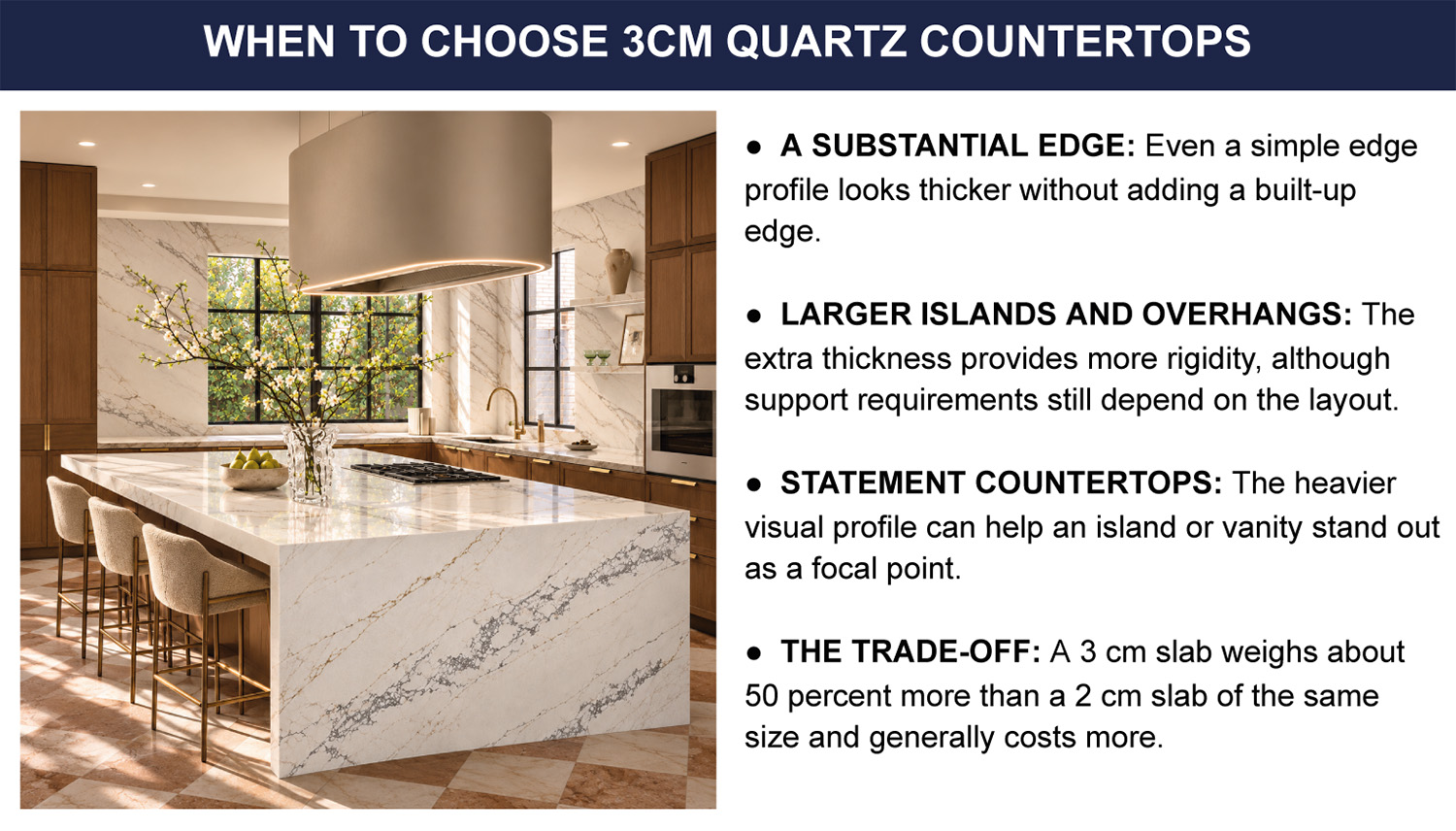
Choose 3 cm quartz when you want a thicker, more substantial countertop, a simple edge that already looks substantial, or more flexibility with islands and overhangs. Because it is thicker and more rigid than 2 cm quartz, it can generally extend farther before additional support is needed.
• A substantial edge: Even a simple edge profile looks thicker without adding a built-up edge.
• Larger islands and overhangs: The extra thickness provides more rigidity, although support requirements still depend on the layout.
• Statement countertops: The heavier visual profile can help an island or vanity stand out as a focal point.
• The tradeoff: A 3 cm slab weighs about 50 percent more than a 2 cm slab of the same size and generally costs more.
When to Choose 2cm Quartz Countertops
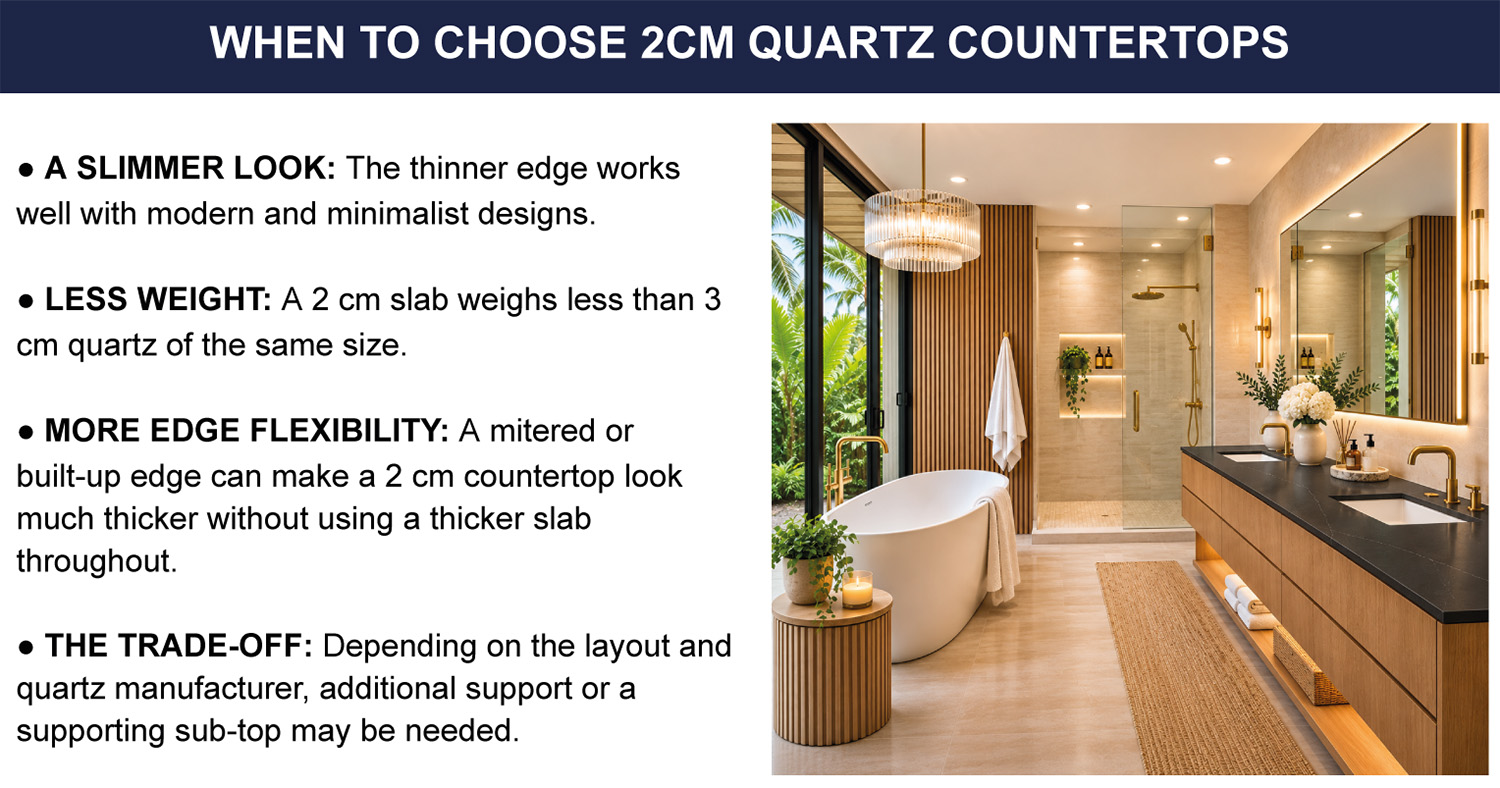
Choose 2 cm quartz when you prefer a slimmer, lighter countertop profile or want a more contemporary look. It works well for countertops and vanities, but may need more support than 3 cm quartz around overhangs, cutouts, and wider spans.
• A slimmer look: The thinner edge works well with modern and minimalist designs.
• Less weight: A 2 cm slab weighs less than 3 cm quartz of the same size.
• More edge flexibility: A mitered or built-up edge can make a 2 cm countertop look much thicker without using a thicker slab throughout.
• The tradeoff: Depending on the layout and quartz manufacturer, additional support or a supporting sub-top may be needed.
Questions to Ask Your Fabricator About Thickness
Ask your fabricator about the slab’s actual thickness, how the top will be supported, and what the finished edge will measure. Those answers tell you whether a quote for 2 cm or 3 cm compares fairly with another, and whether your cabinets and layout can carry it.
About the thickness and support
- What is the actual measured thickness of my slab? Sold sizes are rounded, and manufacturing varies slightly.
- Do you recommend 2 cm or 3 cm for this space, and why?
- What will sit under my top?
- How will overhangs or a bar top be supported? Support depends on thickness and how far the top reaches.
- Do my cabinets need reinforcement or shimming? They have to be flat and sturdy under a heavier slab.
About the edge
- What will the finished edge measure, and is it built up or mitered? The slab and the edge can differ in thickness.
- Which edge profiles does my thickness allow? Some profiles need a minimum thickness.
- Where will any edge seam fall? A carefully made mitered seam can disappear.
About the quote
- Does the quote state the exact brand, color, and thickness? Quotes only compare when all three match.
- Is the edge priced separately? Elaborate edges can raise the cost.
Common Quartz Thickness Mistakes to Avoid
Most thickness problems start with an assumption made before the details are checked. Here are five worth ruling out before you order.
Choosing Thickness for Looks Alone
It is easy to focus on how thick you want your countertop to look, especially when comparing samples. But thickness also affects the weight, how much support the countertop needs, and how far it can extend beyond the cabinets.
For example, a 2 cm countertop with a mitered edge can give you the appearance of a much thicker slab. A 3 cm countertop has that thicker profile naturally, but it also weighs more.
Before making your final choice, talk with your fabricator about the weight, overhangs, and support your cabinets will need. That way, you can get the look you want without creating problems during installation.
Assuming “3cm” Means Exactly 3cm
A 3 cm slab is about 1.18 inches thick and sold as 1 1/4 inches, and makers such as Caesarstone note that minor variations in size and thickness are inherent to manufacturing. That’s enough to matter at a dishwasher, an undermount sink, or an existing backsplash. Ask for the measured thickness of your slab, and measure before you finalize cutouts and fits.
Skipping Support on 2cm Tops and Overhangs
Both 2 cm and 3 cm quartz need proper support, especially around sink cutouts, edges, and overhangs. Because 2 cm quartz is thinner, it usually needs brackets or other reinforcement sooner than 3 cm when the countertop extends beyond the cabinets.
Support requirements can also change from one manufacturer to another, including whether plywood is needed underneath. You may find plenty of advice online, but it is better to have your fabricator confirm the requirements for the exact quartz you are installing.
Forgetting the Weight of Islands and Large Runs
Large islands and long countertop runs can get heavy fast. A 3 cm quartz countertop weighs about 50% more than a 2 cm one, and on a big island, that extra weight adds up.
Before installation, check how the countertop will get into your home and whether your cabinets are level, sturdy, and ready to support it. If you are planning an oversized island, it is also worth having a contractor check the floor structure.
Comparing Quotes Without Matching Thickness and Edge
When comparing countertop quotes, make sure you are looking at the same brand, color, thickness, and edge style. Otherwise, the prices can be misleading.
For example, a 2 cm countertop with a mitered edge can look almost identical to a 3 cm countertop with a simple edge, but the cost may be quite different. Cambria also notes that more detailed edge profiles can increase the price.
Quartz Countertop Thickness & Weight FAQs
Quick answers to common questions about quartz thickness and weight.
How Thick Is a Normal Quartz Countertop?
A normal quartz countertop is 2 cm (about 3/4 inch) or 3 cm (about 1 1/4 inches) thick. Thinner 1 to 1.2 cm slabs are mostly used for walls, backsplashes, and other vertical surfaces.
Is Quartz or Marble Heavier?
Marble is generally a little heavier than quartz when both countertops are the same thickness. ASTM C503, the ASTM International standard specification for marble dimension stone, sets minimum densities of 162 pounds per cubic foot for calcite marble and 175 pounds for dolomitic marble. For comparison, Cambria lists its quartz at 150 pounds per cubic foot.
At 3 cm thick, that works out to roughly 16 pounds or more per square foot for marble, compared with about 13.5 to 15 pounds per square foot for quartz. Actual weight varies by the specific stone or quartz product.
How Big Is a Full Slab of Quartz?
A full quartz slab is about 119 to 122 by 55 to 56.5 inches in a standard size, 126 to 132 by 62.6 to 65.5 in jumbo, and 136 to 140 by 79 to 82 in super jumbo, and sizes vary by brand. For the details, see Quartz Slab Sizes: Standard, Jumbo and Super Jumbo Dimensions.
How Much Is 20 Ft of Quartz Countertops?
Twenty linear feet of standard-depth countertop, about 25.5 inches deep, is roughly 42.5 square feet. That weighs about 380 to 425 pounds at 2 cm and 575 to 640 at 3 cm. Price depends on the brand, color, edge, and fabricator, so ask for an itemized quote. See How Much Do Quartz Countertops Cost?
Is 3cm Quartz Better Than 2cm?
For most kitchen countertops and islands, 3 cm quartz is usually the more practical choice because it is thicker, more rigid, and can generally handle larger spans and overhangs with less additional support. However, 2 cm quartz is also durable and works well when you want a lighter, slimmer look or when the countertop is properly supported.
Both thicknesses offer similar stain resistance and maintenance when comparing the same quartz product. The main differences are structural support, weight, edge appearance, and design flexibility.
Conclusion
With a clear sense of your kitchen needs, choosing between 2cm and 3 cm is easier.
Think about the look you want, how far the countertop will extend beyond the cabinets, and whether the design needs extra support. Your fabricator can help you work through those details and choose a thickness that looks right in your kitchen and holds up to everyday use.
Upgrade Your Cabinets & Countertops With Confidence
Explore beautiful countertop finishes, quality cabinetry, and expert design solutions tailored to your home. Schedule a free consultation by calling (407) 246-0636 or filling out our contact form.
References
- Cambria, Product Specification Sheet (thicknesses, which sizes are for countertops, weight per square foot, density, impact testing): https://www.cambriausa.com/content/dam/cusa/sales-marketing-collateral/product-technical-information/product-specification-sheet-english.pdf
- Cambria, SOP 9.3.3 Installation Requirements for Cambria (overhang limits, substrate, cutout support, sink clips, flatness): https://www.cambriausa.com/content/dam/cusa/sales-marketing-collateral/sops/sop-9.3.3-installation-requirements-for-cambria.pdf
- Cambria, Designing with Depth: A Guide to Countertop Thickness (mitered edges, mixing thicknesses, focal-point vanities): https://www.cambriausa.com/cambria-style/blog/a-guide-to-countertop-thickness
- Cambria, Quartz Countertop Thicknesses and Edge Profiles (no performance difference, built-up edge depths, edge cost): https://www.cambriausa.com/quartz-countertops/thicknesses-edge-profiles
- Cambria, Frequently Asked Questions: https://www.cambriausa.com/quartz-countertops/faq
- Caesarstone US, Design and Specification (slab weights, thickness by color, variation, undermount edge radius, laminated and mitered edges): https://www.caesarstoneus.com/design-and-specification/
- Caesarstone Canada, product page (20 mm/2 cm and 30 mm/3 cm labels, edge thicknesses): https://www.caesarstone.ca/countertops/4030-stone-grey/
- Caesarstone, standard kitchen countertop depth article (25.5 inches): https://www.caesarstoneus.com/blog/what-is-the-standard-depth-of-kitchen-countertops/
- Cosentino, Silestone Countertops Design & Installation manual, Rev. 03, February 2024 (available thicknesses, overhangs, cutout distances, sink support bars, supports): https://assetstools.cosentino.com/api/v1/bynder/doc/0B425745-8BAC-4A87-9D7B54DA7AC39A1D/silestone-installation-manual.pdf
- Cosentino USA, Silestone formats and thicknesses: https://www.cosentino.com/usa/silestone/furniture/
- Corian Design (DuPont), Corian Quartz North America brochure (2 and 3 cm): https://www.corian.com/sites/corian.com/IMG/pdf/corian-inspirational-brochure-na.pdf
- Vicostone, Bizana BQ9415 product page (12 mm option; many colors; lists only 20 and 30 mm): https://prosite.vicostone.com/quartz-stone/bq9415