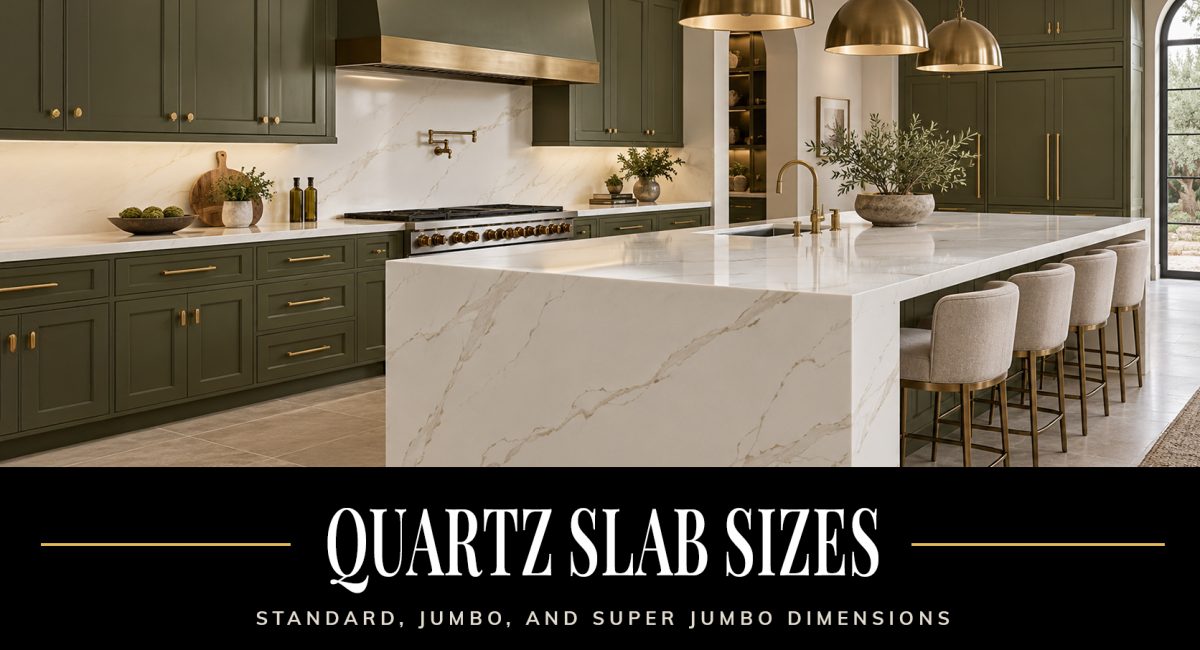
Most quartz slabs run about 119 to 122 inches long by 55 to 56.5 inches wide (standard) or 126 to 132 by 62.6 to 65.5 inches (jumbo), and super jumbo slabs reach about 136 to 140 by 79 to 82 inches. Labels vary by brand, so confirm exact dimensions before planning a layout.
Planning a large island and trying to figure out whether one slab will be enough? Or comparing quotes where one fabricator mentions a standard slab and another recommends a jumbo slab?
Slab size affects where seams land, how much material you need, and how clean the finished countertop looks. It is worth understanding before you fall in love with a color. If you are still comparing materials, start with our complete guide to quartz countertops.
Key Takeaways
Here’s the quick summary of our guide.
- Standard slabs run about 119 to 122 inches long and 55 to 56.5 inches wide, jumbo slabs about 126 to 132 by 62.6 to 65.5 inches, and super jumbo slabs about 136 to 140 by 79 to 82 inches.
- Slab area in square feet equals length times width in inches, divided by 144, which gives roughly 46 to 60 square feet for standard and jumbo slabs.
- “Standard” and “jumbo” are brand labels, not industry-wide sizes, so compare inches, not names.
- The full slab is larger than the piece you can use, so ask your fabricator for the largest piece they can cut, as Cambria advises.
Quartz Slab Sizes at a Glance
Here’s how typical slab sizes compare. All figures are approximate.
| Slab type | Length (inches) | Width (inches) | Area (square feet) |
|---|---|---|---|
| Standard slab | 119 to 122 inches | 55 to 56.5 inches | 46 to 47 sq. ft. |
| Jumbo slab | 126 to 132 inches | 62.6 to 65.5 inches | 55 to 60 sq. ft. |
| Super jumbo slab | Lenght 136 to 140 inches | Width 79 to 82 inches | Square feet 75 to 80 sq. ft. |
Countertop slabs are typically 2 cm (approx. 3/4 inch) or 3 cm (approx. 1 1/4 inches) thick, and exact sizes vary by brand, color, and collection.
Note: The exact size of engineered quartz slabs varies by manufacturer, color, and collection. At i4 Kitchen & Bath, we work with leading engineered quartz brands such as Cambria, Silestone, and Corian Quartz.

Quartz Slab Size and Dimensions: What Size Does a Slab of Quartz Come In?
Quartz slabs come in three main size classes. A standard slab is about 119 to 122 inches long and 55 to 56.5 inches wide, a jumbo slab about 126 to 132 inches long and 62.6 to 65.5 inches wide, and a super jumbo slab about 136 to 140 inches long and 79 to 82 inches wide.
Each brand sets its own standard, jumbo, and super jumbo sizes, so the numbers shift from one manufacturer to the next. Cambria (American-made) lists a standard slab at 122 by 55.5 inches, and Silestone (from Spain’s Cosentino) at about 118.9 by 55.1.
What Size Are Quartz Slabs? Size of Quartz Slabs in Inches, Feet and Centimeters
To convert slab dimensions, divide inches by 12 to get feet, or multiply inches by 2.54 to get centimeters. A standard slab of about 119 to 122 by 55 to 56.5 inches is roughly 10 by 4.6 to 4.7 feet, or 302 to 310 by 140 to 144 centimeters.
| Slab | Inches (length by width) | Feet (length by width) | Centimeters (length by width) |
|---|---|---|---|
| Standard slab (general range) | 119 to 122 by 55 to 56.5 inches | 9.9 to 10.2 by 4.6 to 4.7 feet | 302 to 310 by 140 to 144 centimeters |
| Jumbo slab (general range) | 126 to 132 by 62.6 to 65.5 inches | 10.5 to 11.0 by 5.2 to 5.5 feet | 320 to 335 by 159 to 166 centimeters |
| Super jumbo slab (general range) | 136 to 140 by 79 to 82 inches | 11.3 to 11.7 by 6.6 to 6.8 feet | 345 to 356 by 201 to 208 centimeters |
| Cambria standard (approx.) | 122 by 55.5 inches | 10.2 by 4.6 feet | 310 by 141 centimeters |
| Cambria jumbo | 132 by 65.5 inches | 11.0 by 5.5 feet | 335 by 166 centimeters |
| Cambria super jumbo (approx.) | 136 by 80 inches | 11.3 by 6.7 feet | 345 by 203 centimeters |
| Silestone standard | 118.9 by 55.1 inches | 9.9 by 4.6 feet | 302 by 140 centimeters |
| Silestone jumbo | 126 by 62.6 inches | 10.5 by 5.2 feet | 320 by 159 centimeters |
| Corian Quartz (featured colors) | 130 by 65 inches | 10.8 by 5.4 feet | 330 by 165 centimeters |
Sources: Cambria’s Product Specification Sheet, Cosentino’s Silestone page, and Corian’s North America brochure. Cambria and Corian note that availability varies by design or color.
You may also see millimeters on some spec sheets. The metric section later in this guide covers those.
Standard Size of Quartz Slab
A standard quartz slab is usually about 119 to 122 inches long and 55 to 56.5 inches wide. However, slab-size labels are not standardized across the industry, so one manufacturer’s standard slab may be close in size to another manufacturer’s jumbo slab. Always confirm the actual dimensions when comparing products or quotes.
Brands draw the line differently. Cambria’s standard slab is about 3 inches longer than Silestone’s, and Corian Quartz lists a single size for its featured colors that falls in the jumbo range.
Don’t be surprised if the numbers shift a little. Cosentino’s Silestone page lists a standard slab 118.9 inches long, while its FAQ says about 120.5 inches. A couple of inches can decide whether a long island fits on one slab, so get the exact size for your color from your fabricator before you plan seams.
Typical and Average Quartz Slab Size
A typical standard slab is about 119 to 122 by 55 to 56.5 inches, and a typical jumbo slab is about 126 to 132 by 62.6 to 65.5 inches. The midpoint of those ranges, a handy average, is about 120 by 56 inches for standard and about 129 by 64 inches for jumbo.
These averages are based on the published slab sizes from Cambria, Silestone, and Corian Quartz. They are helpful for rough planning, like getting a general idea of whether a long countertop run might fit on one slab.
The final answer still comes from your fabricator’s layout. Once they account for usable slab area, seams, cutouts, veining, and waste, the real slab plan can change.
How Many Square Feet Are in a Slab of Quartz?
A quartz slab covers about 46 to 60 square feet, with standard slabs at about 46 to 47 and jumbo slabs at about 55 to 60, based on published sizes from Cambria, Silestone, and Corian Quartz. To find any slab’s area, multiply length by width in inches, then divide by 144 to convert square inches to square feet.
Here’s the square-feet table with the unit in every cell, matching the conversion table.
| Slab | Area (square feet) |
|---|---|
| Standard slab (general range) | 46 to 47 square feet |
| Jumbo slab (general range) | 55 to 60 square feet |
| Super jumbo slab (general range) | 75 to 80 square feet |
| Cambria standard (approx.) | 47 square feet |
| Cambria jumbo | 60 square feet |
| Cambria super jumbo (approx.) | 76 square feet (nominal) |
| Silestone standard | 46 square feet |
| Silestone jumbo | 55 square feet |
| Corian Quartz (featured colors) | 59 square feet |
Here’s the math for a standard slab of about 120 by 55 inches: 120 times 55 is 6,600 square inches. A square foot is 12 inches by 12 inches, or 144 square inches, so 6,600 divided by 144 is about 46 square feet. The brand rows use the same math with each brand’s exact size, and Cambria’s match the square footage on its own spec sheet.
Those figures are for the full slab. Cambria’s spec sheet asks you to check the largest piece that can be fabricated against the slab size listed, so plan your square footage around that piece.
Jumbo Quartz Slab Size
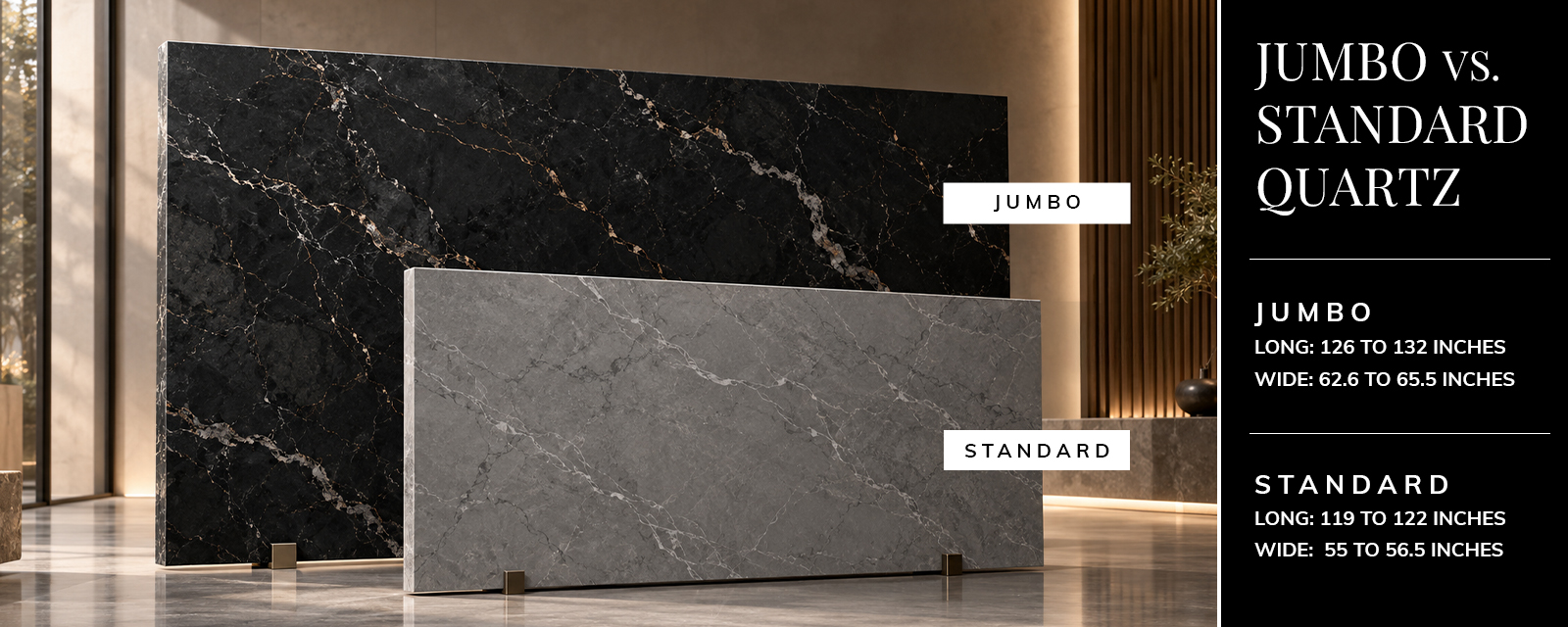
A jumbo quartz slab is about 126 to 132 inches long and 62.6 to 65.5 inches wide, or roughly 55 to 60 square feet. A common size is 130 by 65 inches, listed by Corian Quartz and Vicostone, while Cambria’s jumbo runs a little larger and Silestone’s a little smaller.
Jumbo vs. Standard Quartz Slabs
A jumbo slab is roughly 7 to 10 inches longer and wider than a standard one, adding about 20 to 28 percent more surface area. That extra size affects how many seams a large island or long run needs, since a bigger slab can cover more countertop in one piece.
What the difference means in practice:
Seams: A larger slab gives your fabricator more room to work with, so some long islands or countertop runs may need fewer seams. The final seam plan still depends on the layout.
Cost: Jumbo slabs include more material, so the price can be different from a standard slab. Your actual cost depends on the slab, the layout, the seams, and how much material is needed.
Installation: Bigger slabs are heavier and harder to move. Before choosing one, ask your fabricator about access into the home, tight turns, stairs, elevators, and handling.
Why “Standard” and “Jumbo” Mean Different Sizes by Brand
Each brand uses its own size categories and labels, so the same slab dimensions may be described differently from one manufacturer to another. For example, Vicostone calls a 130 by 65-inch slab jumbo, while Corian Quartz lists the same 130 by 65-inch size without labeling it standard or jumbo.
| Brand | Standard | Jumbo | Super jumbo |
|---|---|---|---|
| Cambria | 122 by 55.5 inches (approx.) | 132 by 65.5 inches | 136 by 80 inches (approx.) |
| Silestone | 118.9 by 55.1 inches | 126 by 62.6 inches | None listed |
| Caesarstone | 120 by 56.5 inches | Varies by color, including 128 by 64.5 and 131.5 by 64.5 inches | None listed |
| Corian Quartz | 120 by 63 inches | 130 by 65 inches | None listed |
| Vicostone | 119 by 56 inches (“normal” size) | 130 by 65 inches | 136 by 79 inches |
Super Jumbo Quartz Slab Size
Super jumbo quartz slabs are about 136 to 140 inches long and 79 to 82 inches wide, or roughly 75 to 80 square feet. That’s about 60 to 75 percent more surface than a standard slab, which makes them a good fit for large islands and waterfall edges.
Cambria lists about 136 by 80 inches, and Vicostone lists 136 by 79 inches. They come in select colors only: Vicostone introduced its super jumbo in a curated range of colors, and Cambria says availability varies by design.
Why people choose super jumbo:
Fewer seams: A larger slab can cover more of the countertop in one piece, which can help reduce seams on big islands or long countertop runs.
Waterfall edges: The added length and width can make it easier to continue the same material down the side of an island for a cleaner, more custom look.
Continuous pattern: A larger slab gives the pattern more room to run. Veining, color, and movement can carry across the countertop more naturally, with fewer stops in the design.
Mega Jumbo Quartz Slabs: Are They the Same as Super Jumbo?
Generally, yes. Mega jumbo and super jumbo both describe the largest quartz slabs, about 136 to 140 inches long and 79 to 82 inches wide, though neither term has a standard definition. Cambria and Vicostone use “super jumbo,” so if a supplier says “mega,” ask for the exact dimensions.
Largest Quartz Slab Size
Some of the largest quartz slabs are sold as super jumbo, with sizes around 136 inches long and 79 to 80 inches wide, or roughly 75 to 76 square feet. Cambria lists a super jumbo slab at approximately 136 by 80 inches, while Vicostone lists 136 by 79 inches.
Keep in mind that the slab is only the starting size. The largest finished piece that can be cut from it may be smaller because fabrication requires room for trimming, edges, cutouts, and other details. Cambria’s spec sheet advises checking the largest piece that can be fabricated against the slab size listed, so ask your fabricator how big a single piece can be in your color.
Who Makes Super Jumbo Quartz Slabs?
Several quartz makers offer super jumbo slabs, including Cambria, Vicostone, and Verona Quartz Surfaces, a Los Angeles-based wholesale brand. Not every brand offers this size, and where it does, it’s usually limited to select colors or designs, so always check availability.
| Brand | Super jumbo size listed |
|---|---|
| Cambria | About 136 by 80 inches (nominal 76 square feet) |
| Vicostone | 136 by 79 inches |
| Verona Quartz Surfaces | 138 by 79 inches |
| Silestone | None listed (standard and jumbo only) |
| Caesarstone | None listed (standard and jumbo only) |
| Corian Quartz | None listed (130 by 65 inches for featured colors) |
Of the three brands we carry, Cambria currently lists a super jumbo, and even there, availability varies by design, so check your color before you plan around it.
Quartz Slab Sizes by Brand
Quartz slab sizes vary by brand, but most fall into three classes: standard at about 119 to 122 by 55 to 56.5 inches, jumbo at about 126 to 132 by 62.6 to 65.5, and super jumbo at about 136 to 140 by 79 to 82. Across brands, standard lengths differ by about 3 inches and jumbo lengths by about 6.
Cambria Quartz Jumbo Slab Size
A Cambria jumbo slab measures 132 by 65.5 inches, or about 60 square feet. By comparison, its standard slab measures about 47 square feet.
Cambria also lists a super jumbo option at approximately 136 by 80 inches, with a nominal area of 76 square feet. Availability can vary by design, and the largest piece that can actually be fabricated may be smaller than the full slab. So if you are planning a large island or another wide, uninterrupted surface, ask your fabricator which slab sizes are available in your chosen color and how large a single finished piece can be.
Silestone Jumbo Slab Size
A Silestone jumbo slab is typically about 126 by 62.6 inches, or roughly 55 square feet. By comparison, a standard Silestone slab is about 46 square feet. Most Silestone colors are available in both standard and jumbo formats.
Exact slab dimensions can change a little by color, collection, and product line. Some jumbo slabs, for example, measure closer to 128 by 63 inches.
If you are planning a large island or trying to reduce seams, check the actual slab size for the color you choose before the layout is finalized. That small step can save a lot of back-and-forth later.
Caesarstone Slab Sizes
Caesarstone standard slabs measure about 120 by 56.5 inches, or roughly 47 square feet. Jumbo sizes vary by design, with common dimensions including 128 by 64.5 inches and 131.5 by 64.5 inches, giving you about 57 to 59 square feet of material.
Because slab dimensions can vary slightly, it is smart to confirm the exact size of your selected color before planning a large island, backsplash, or other surface where seam placement matters. Also, be careful when comparing products, since Caesarstone porcelain comes in different slab dimensions than its quartz surfaces.
Quartz Worktop Slab Sizes: Metric Sizes in Millimeters
Quartz worktop slabs, called countertop slabs in the U.S., measure about 3,020 to 3,100 by 1,395 to 1,440 millimeters for standard, 3,200 to 3,355 by 1,590 to 1,665 for jumbo, and 3,450 to 3,560 by 2,005 to 2,085 for super jumbo.
| Slab | Millimeters (length by width) | Inches (length by width) |
|---|---|---|
| Standard slab (general range) | 3,020 to 3,100 by 1,395 to 1,440 millimeters | 119 to 122 by 55 to 56.5 inches |
| Jumbo slab (general range) | 3,200 to 3,355 by 1,590 to 1,665 millimeters | 126 to 132 by 62.6 to 65.5 inches |
| Super jumbo slab (general range) | 3,450 to 3,560 by 2,005 to 2,085 millimeters | 136 to 140 by 79 to 82 inches |
“Worktop” is the British term for countertop, and you’ll often see slab dimensions given in millimeters on UK, European, and international spec sheets. For example, Cambria’s standard and jumbo slabs are equivalent to 3,100 by 1,410 millimeters and 3,350 by 1,660 millimeters. Caesarstone lists 3,050 by 1,440 millimeters for standard and 3,270 by 1,640 millimeters for jumbo, while Vicostone lists 3,300 by 1,650 millimeters for jumbo and 3,454 by 2,007 millimeters for super jumbo.
How to Choose a Quartz Slab Size
The right slab size depends on how much countertop you need, how it’s laid out, and whether your color comes in the size you want. Start with the number of slabs, then work through seams and fit.
How Many Slabs Do I Need?
Most small kitchens or single islands need about one quartz slab, while larger L-shaped, U-shaped, or spacious kitchens often need two or more. The exact number depends on your countertop square footage, slab size, layout, cutouts, and seam placement, so your fabricator’s slab layout gives the most accurate answer.
As a rough starting point, a standard quartz slab provides about 46 to 47 square feet of material, while a jumbo slab provides about 55 to 60 square feet. However, you cannot simply divide your countertop square footage by the slab area. Sink cutouts, corners, grain or veining direction, backsplash pieces, and usable slab dimensions can all affect how much material is needed.
For a rough countertop estimate, start by measuring each section in inches. Multiply the length by the depth, then divide by 144 to get square feet.
Do that for every countertop run, then include anything extra, like a backsplash or waterfall panel.
After that, compare your total square footage to the slab size and round up. That will give you a rough idea, but not the final answer. Your fabricator still has to map out the real slab layout, including seams, sink cutouts, veining, and waste, before they can tell you how many slabs the project will actually need.
Can a 10-Foot Island Come From One Slab?
Yes, a 10-foot island can come from one slab, but it takes a jumbo or super jumbo. A 10-foot island top is 120 inches long, and a standard slab is 119 to 122 inches; the piece you can cut is shorter than the slab itself.
| Slab class | Slab length (inches) | Compared with 120 inches |
|---|---|---|
| Standard | 119 to 122 inches | 1 inch shorter to 2 inches longer |
| Jumbo | 126 to 132 inches | 6 to 12 inches longer |
| Super jumbo | 136 to 140 inches | 16 to 20 inches longer |
Think of those measurements as the most you could get in a perfect layout. In real fabrication, some of the slab gets used for edge clearance, cutouts, waste, and lining up the pattern.
Island depth is another thing to check. A standard slab is usually about 55 to 56.5 inches wide, so if your island is deeper than that, you may need a seam or a larger slab.
Two things to check before you commit:
Weight and transport: Quartz is heavy, especially in larger slabs. According to Cambria’s specification sheet, its 2 cm slab, about ¾ inch thick, weighs roughly 10 pounds per square foot, and its 3 cm slab, about 1¼ inches thick, weighs about 15 pounds per square foot.
That means a Cambria jumbo slab of about 60 square feet can weigh about 600 pounds at 2 cm and about 900 pounds at 3 cm. That is a lot of material to move through a house, especially if there are narrow doorways, tight corners, stairs, or elevators involved.
Before you choose a jumbo slab, ask your fabricator about access. They will need to plan how the slab gets delivered, carried, and installed safely.
Cabinet and layout: the finished top is longer than your cabinets once you add the overhang at each end, so check that total length against the slab, not the cabinet length. Overhang beyond a certain length also needs extra support, which Quartz Countertop Thickness: 2cm vs. 3cm, Standard Options and Weight covers.
Standard or Jumbo: Which Slab Size Fits Your Project?
Choose a jumbo slab when your island or longest run is close to or longer than a standard slab, about 119 to 122 inches, because a larger slab can avoid a visible seam. Choose standard for perimeter runs and smaller islands. Neither is better in every kitchen, and whether your color comes in jumbo often decides it.
| Factor | Standard fits when | Jumbo or super jumbo fits when |
|---|---|---|
| Length of your longest unbroken piece | It is comfortably shorter than 119 to 122 inches | It is close to or longer than 119 to 122 inches (jumbo reaches 126 to 132 inches, super jumbo 136 to 140) |
| Depth of the piece, such as an island’s width | It fits within 55 to 56.5 inches | It needs more width (jumbo is 62.6 to 65.5 inches wide, super jumbo 79 to 82) |
| Layout | Perimeter runs and several shorter pieces | A long island, or a layout where one piece can replace a seam |
| Pattern and edges | A seam in the pattern is acceptable | You want veining to run unbroken or a waterfall edge |
| Color | Your color comes in standard | Your color comes in jumbo, since availability varies by design |
| Access | Doors and stairs are not a concern | Access is tight, so ask your fabricator first, since a larger slab is heavier |
| Budget | Its itemized quote comes out lower | Fewer seams or fewer slabs bring its quote lower |
Slab Size, Seams and Cost
Slab size sets how many seams a layout needs, and both seams and slab count affect cost. A larger slab can mean fewer seams but holds more material, so only an itemized quote shows which option costs less for your layout.
Seams: a run longer than the slab’s usable length needs one, and L-shaped or U-shaped layouts split across pieces. Seams are usually visible on quartz countertops, so placement and pattern matching matter. Cambria, for example, says the pattern and shade can change at a seam.
Cost: Quartz pricing varies by brand, slab size, design, fabrication, seams, and installation.
As one real-world example, Cambria estimates installed countertop costs at about:
- Small Kitchen (30- to 50-square-foot ): $2,400 to $6,500+ for a small
- Medium Kitchen (50- to 100-square-foot): $4,000 to $13,500
- Large Kitchen (100- to 150-square-foot): $8,000 to $19,500+
These are guiding estimates, not fixed prices, so compare quotes based on the complete project rather than price per square foot alone. Ask for a quote that shows the slabs, fabrication, and seams separately.
Questions to Ask Your Fabricator About Slab Size
Ask your fabricator for the exact slab size in your color, the largest single piece they can cut from it, and where the seams will fall. Those three answers tell you whether a standard, jumbo, or super jumbo slab fits your layout.
About the slab
- What is the exact size of the slab in my color, in inches? Published sizes differ by an inch or two, and by color.
- What is the largest single piece you can cut from it? Edge margins, cutouts, and pattern matching use part of the slab.
- Does my color come in jumbo or super jumbo, in the thickness I want? Availability varies by design and color.
About the layout
- Can I see a layout of my pieces on the slabs? It shows where seams fall and what’s left over.
- Where will the seams go, and how will the pattern match across them? Seams will be visible, so placement matters.
- If my project needs more than one slab, will they come from the same batch? Color and pattern vary slightly from slab to slab.
Common Quartz Slab Size Mistakes to Avoid
Most slab size problems start with an assumption made before the layout is drawn. Here are five worth checking before you order.
Assuming the Nominal Size Is the Usable Size
The size listed on the slab is not the same as the piece your fabricator can actually use. Some material gets lost to edge margins, sink and cooktop cutouts, waste, and pattern matching.
There can also be small size tolerances from the manufacturer. For example, Caesarstone’s jumbo slabs allow a tolerance of plus or minus 1.5 percent, which is close to 2 inches on a 128-inch slab.
That is why a 120-inch island on a slab listed at 122 inches can be risky. On paper, it sounds like it fits. In real fabrication, there may not be enough room. Before you finalize the layout, ask your fabricator for the largest cuttable piece from the slab you are considering.
Assuming “Jumbo” Means the Same Thing Everywhere
“Jumbo” does not mean one universal slab size. Each brand uses the label a little differently. For example, a jumbo slab may be around 126 inches long with Silestone and around 132 inches long with Cambria. That 6-inch difference can be enough to change the seam plan on a long island.
When a quote says “jumbo,” ask for the actual length and width in inches. Also ask which brand’s jumbo size the fabricator is using, because that detail can affect layout, seams, and cost.
Assuming Every Color Comes in Jumbo
Jumbo slab availability is not the same across every brand. Some brands offer jumbo sizes in select colors, while others make them available in most of their collection.
For example, Cosentino says most Silestone colors come in both standard and jumbo formats. Cambria notes that slab size can vary by design. Caesarstone lists available sizes by individual color.
Super jumbo slabs are usually more limited. Brands like Vicostone tend to offer them in selected designs, not every color in the collection.
That is why it is best to fall in love with the color first, then check which slab sizes are available in that exact design. The size options can change from one color to the next.
Ordering by Square Footage Without a Seam Layout
Square footage gives you the rough amount of countertop you need. The seam layout tells you how many slabs you actually need.
That is where homeowners can get surprised. Countertop pieces are often long and narrow, and they do not always fit neatly onto a slab just because the math looks close. A kitchen with 40 square feet of countertop may seem like it should fit on one standard slab of about 46 to 47 square feet. But once the fabricator maps out the pieces, seams, sink cutouts, waste, and pattern direction, the project may still need two slabs.
Overlooking the Weight of Large Slabs
Jumbo and super jumbo slabs are not just larger. They are heavier, harder to move, and more demanding to install.
Before the slab arrives, your fabricator needs to think through the delivery path. Can the crew get it through the front door? Around tight corners? Up stairs? Into an elevator? The cabinets and island supports also need to be ready to carry the weight.
For more detail on weight by thickness, see Quartz Countertop Thickness: 2cm vs. 3cm, Standard Options and Weight.
Quartz Slab Size FAQs
Quick answers to common questions about quartz slab sizes.
How Much Does a Jumbo Slab of Quartz Cost?
A jumbo slab’s price depends on the brand, color, thickness, finish, and your fabricator, and published figures vary too widely to quote. Dealers and fabricators set the price, so ask for an itemized quote. For what drives the total, see How Much Do Quartz Countertops Cost?
What Is the Standard Size of a Quartz Slab?
A standard quartz slab is about 119 to 122 inches long and 55 to 56.5 inches wide, or roughly 46 to 47 square feet. Brands set their own sizes, and some suppliers call a larger slab of 126 by 63 to 64 inches standard, so confirm the exact size for your color.
How Big Is a Jumbo Slab of Cambria Quartz?
A Cambria jumbo slab measures 132 by 65.5 inches, about 60 square feet, according to Cambria’s FAQ and specification sheet. That compares with 122 by 55.5 inches for Cambria’s standard slab and about 136 by 80 inches for its super jumbo, which comes in select designs.
How Big Are Silestone Jumbo Slabs?
A Silestone jumbo slab measures about 126 by 62.6 inches, roughly 55 square feet, according to Cosentino’s U.S. website. Most Silestone colors come in both standard and jumbo formats. Cosentino’s FAQ lists a slightly longer jumbo, about 128 inches, so confirm the exact size for your color.
What Is the Largest Size Quartz Slab Available?
The largest quartz slabs are super jumbo, about 136 to 140 inches long and 79 to 82 inches wide, or roughly 75 to 80 square feet. Keep in mind super jumbo slabs come in select colors only.
Conclusion
Slab size is one of those details that does not feel important until a seam shows up where you were not expecting it.
A few inches can change whether an island can be cut from one piece, where the pattern breaks, and how much material the project needs. Once you know your longest countertop section and the real slab size for the color you want, the layout becomes much easier to plan.
Expert Kitchen Designers. Stunning Results.
Reimagine the heart of your home. Schedule a free consultation by calling (407) 246-0636 or filling out a contact form.
References
- Cambria, Frequently Asked Questions (slab sizes, seams, who sets pricing, confirming the largest piece): https://www.cambriausa.com/quartz-countertops/faq
- Cambria, Product Specification Sheet (slab sizes and areas, super jumbo, weight per square foot, samples, seams): https://www.cambriausa.com/content/dam/cusa/sales-marketing-collateral/product-technical-information/product-specification-sheet-english.pdf
- How Much Do Quartz Countertops Cost? https://www.cambriausa.com/cambria-style/blog/how-much-do-quartz-countertops-cost
- Cosentino USA, Silestone formats and sizes (standard and jumbo, availability across colors, FAQ): https://www.cosentino.com/usa/silestone/furniture/
- Caesarstone US, Design and Specification (standard and jumbo sizes, tolerance, thicknesses, selecting the actual slab): https://www.caesarstoneus.com/design-and-specification/
- Caesarstone US, Countertops page (standard 120 by 56.5 inches, jumbo sizes by color): https://www.caesarstoneus.com/countertop/
- Corian Design (DuPont), Corian Quartz North America brochure (130 by 65 inches for featured colors): https://www.corian.com/sites/corian.com/IMG/pdf/corian-inspirational-brochure-na.pdf
- Vicostone, Vicostone Expands Design Possibilities with Super Jumbo Slabs (345 by 201 centimeters, 136 by 79 inches): https://prosite.vicostone.com/news/2025-03-19/vicostone-expands-design-possibilities-with-super-jumbo-slabs
- Vicostone Australia, Unveiling the New Horizon: Vicostone Super Jumbo (curated color range): https://www.eco.vicostone.com/news/unveiling-the-new-horizon-vicostone-super-jumbo
- Vicostone U.S., product page (normal 119 by 56 and jumbo 130 by 65 inches): https://us.vicostone.com/en/quartz-stone/BQ8918
- Verona Quartz Surfaces, Super Jumbo Quartz Slabs post (138 by 79 inches, 75.7 square feet): https://business.google.com/v/verona-quartz-surfaces/02292797440525663635/f293/_/lp/7103652181894737989/