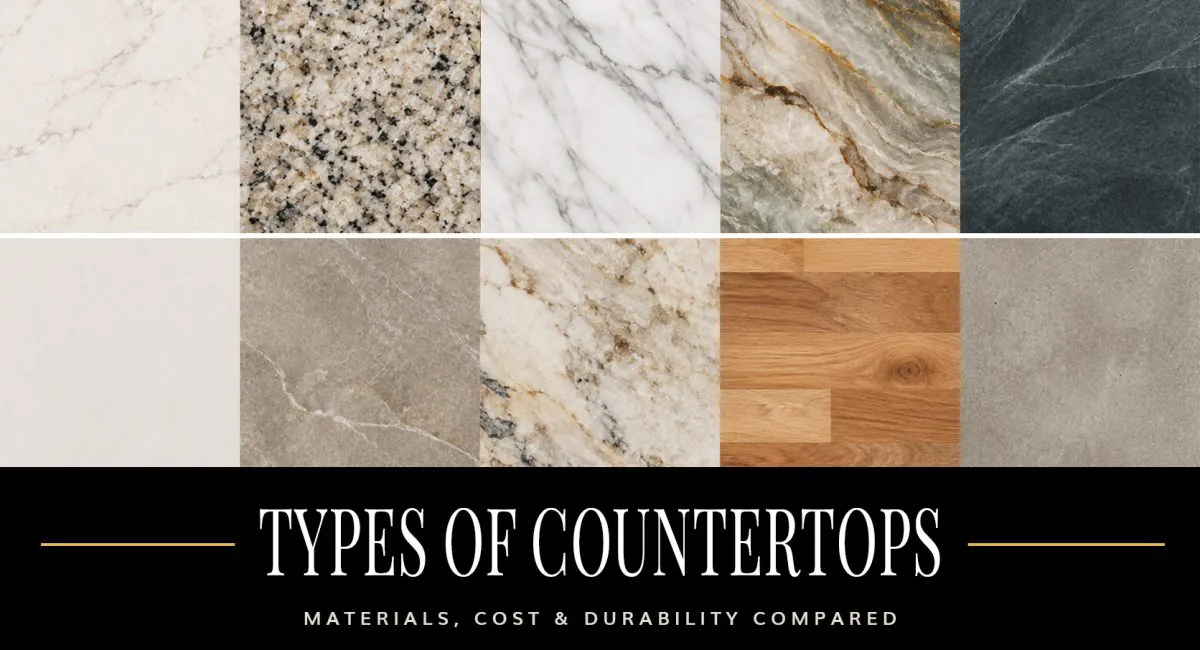
The main types of countertops fall into several groups: natural stone, including granite, quartzite, marble, and soapstone; engineered (manufactured) surfaces, including quartz and solid surface; porcelain and sintered surfaces, made from minerals baked at intense heat; and other materials such as laminate, butcher block, concrete, tile, and stainless steel.
Picturing new counters in your kitchen? That’s the fun part! It can also feel like a lot of choices at once. The good news: once you know the groups, the few that fit your life usually stand out fast.
Key Takeaways
Three habits make any countertop choice easier.
- Weigh durability, upkeep, and budget against how you really use your kitchen, not against a single “best” material.
- Ask for the care guide for the exact product you like, since care varies by material and brand.
- See a full slab or large sample in person before you decide.
Types of Countertops at a Glance
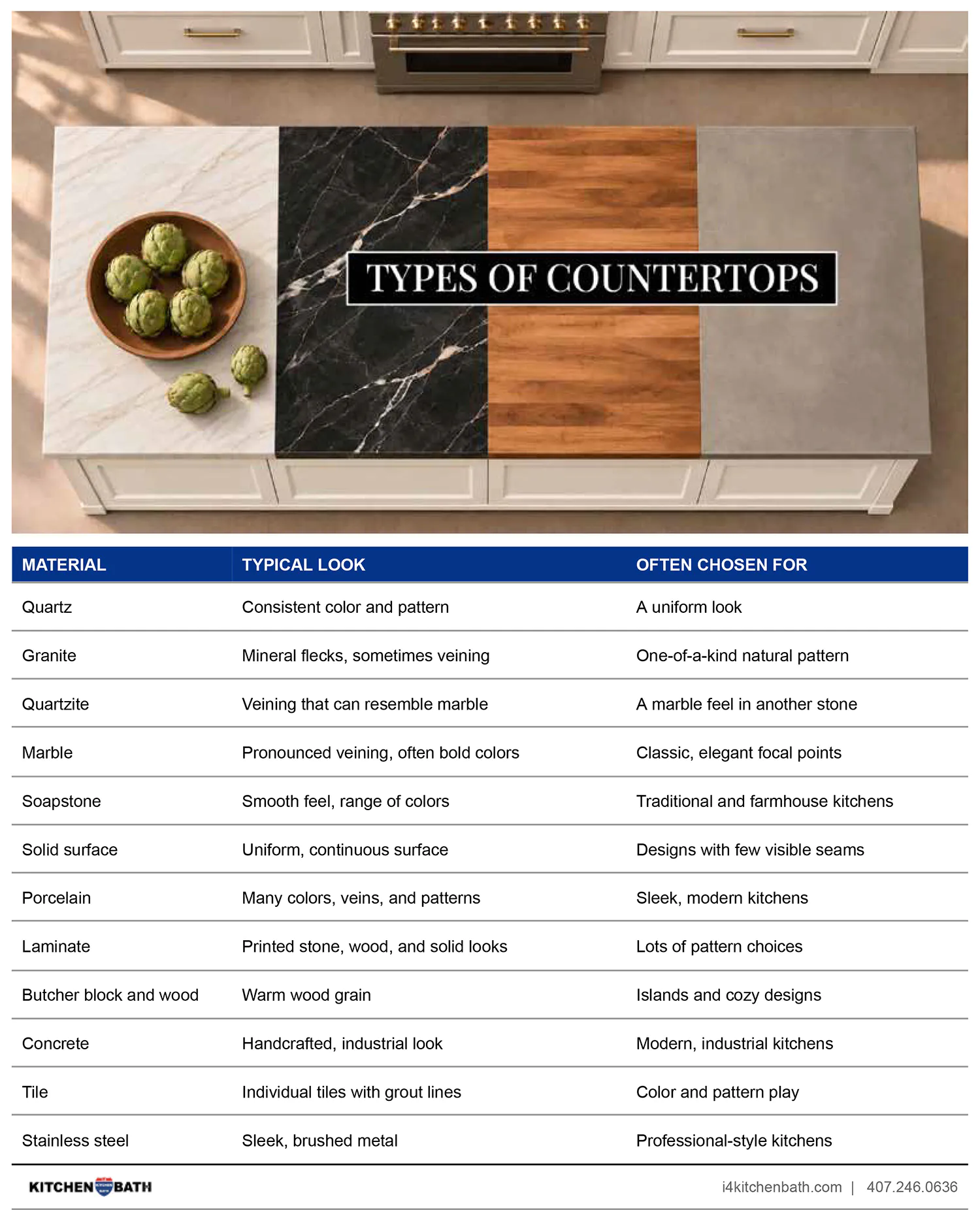
| MATERIAL | TYPICAL LOOK | OFTEN CHOSEN FOR |
|---|---|---|
| Quartz | Consistent color and pattern | A uniform look |
| Granite | Mineral flecks, sometimes veining | One-of-a-kind natural pattern |
| Quartzite | Veining that can resemble marble | A marble feel in another stone |
| Marble | Pronounced veining, often bold colors | Classic, elegant focal points |
| Soapstone | Smooth feel, range of colors | Traditional and farmhouse kitchens |
| Solid surface | Uniform, continuous surface | Designs with few visible seams |
| Porcelain | Many colors, veins, and patterns | Sleek, modern kitchens |
| Laminate | Printed stone, wood, and solid looks | Lots of pattern choices |
| Butcher block and wood | Warm wood grain | Islands and cozy designs |
| Concrete | Handcrafted, industrial look | Modern, industrial kitchens |
| Tile | Individual tiles with grout lines | Color and pattern play |
| Stainless steel | Sleek, brushed metal | Professional-style kitchens |
Types of Countertop Materials
The different kinds of countertop materials for kitchens range from natural stone, engineered surfaces, and porcelain to wood, metal, tile, and laminate. Each kind of countertop has its own look, feel, and care routine, so the right one depends on how you cook, clean, and live.
“Worktop” is the British English term for a countertop, according to Oxford Learner’s Dictionaries. So kitchen worktops, from stone worktops to solid wood ones, are the same surfaces under another name.
Quartz Countertops
Quartz countertops are engineered, meaning manufactured, surfaces, not natural stone. The Natural Stone Institute, the stone industry’s trade association, notes that quartzite is a natural stone and shouldn’t be confused with manufactured quartz.
See Quartz Countertops: The Complete Guide.
Types of Stone Countertops
Granite and quartzite are both quarried natural stones. According to the Natural Stone Institute, quartzite is generally harder and denser than granite and highly resistant to chemicals and scratches.
Compare them in Types of Stone Countertops.
Solid Surface Countertops
Solid surface is a manufactured material first made under the brand Corian. Corian Design, its maker, describes it as about one-third acrylic resin and two-thirds natural minerals, and nonporous, meaning liquids can’t soak in. Matching sinks can join it as one continuous surface.
See Solid Surface Countertops.
Marble Countertops
Marble is a classic natural stone with a sensitive side. It’s calcareous, meaning it’s made mainly of calcium carbonate, which reacts with acids. The Natural Stone Institute notes that lemon, vinegar, and other acids may dull or etch marble, eating into its finish. A stone professional can usually refinish etched spots.
To see how marble compares with granite and quartz, read Marble vs. Granite vs. Quartz.
Porcelain Countertops
Porcelain countertops are slabs made from clay and minerals fired at very high temperatures. Caesarstone, a countertop maker, describes porcelain as resistant to ultraviolet (UV) light from the sun and slow to absorb water, though it can crack under a hard blow. Sintered surfaces, such as Dekton, are a closely related category.
Laminate Countertops
Laminate countertops typically have a printed decorative layer bonded to a wood-based core, such as particleboard. According to Wilsonart, a laminate manufacturer, always use a heat shield, hot pad, or trivet, because pots and dishes straight from the oven or burner can crack or blister the surface.
Butcher Block and Wood Countertops
Butcher block countertops are strips of wood glued into one solid top, while other wood counters use wider planks. Either way, wood brings a warmth that’s hard to match. An oil finish typically needs fresh oil at least once a month, and liquids left standing can soak in and soften the wood. On the plus side, minor scratches can usually be sanded out.
See Best Wood for Kitchen Countertops.
Concrete Countertops
Concrete countertops are made from a cement-based mix, typically cast in a mold in a workshop and sometimes poured in place, according to the Concrete Countertop Institute’s founder. Because each top is made to fit, shapes, edges, and colors can usually be customized. Finishing and protection methods vary, so ask your countertop maker how they treat the surface.
Soapstone Countertops
Soapstone is a natural stone with a talent cooks appreciate. The Natural Stone Institute describes it as highly resistant to chemicals and able to absorb and distribute heat. That makes it well suited to countertops and to surrounds for fireplaces and wood stoves.
If you’re in Central Florida, you can explore soapstone and our other materials on our countertops in Orlando page.
Tile Countertops
Tile countertops are made from individual ceramic, porcelain, or stone tiles set side by side, with grout, a mortar-like filler, in the joints. That opens up endless colors, shapes, and patterns. Glazed tile, coated in a glass-like finish, typically needs little care, but the grout is another story: standard cement-based grout usually needs sealing to resist stains, while resin-based epoxy grout usually doesn’t.
See Modern Tile Countertops.
Stainless Steel Countertops
Stainless steel countertops bring a professional-kitchen look home. They often suit a busy prep zone, a sink run with a matching steel sink, or an island in an industrial-style kitchen. Euro Inox, a European stainless steel industry association, describes the surface as smooth, nonporous, and easy to clean, and resistant to stains from foods like tomatoes and fruit juices. It warns that bleach, other chloride cleaners, and abrasive scouring powders can corrode or scratch it.
Best Materials for Modern Kitchens
There’s no single best material for a modern kitchen, but a few fit common modern priorities. For a clean, consistent look, homeowners often lean toward quartz, solid surface, or porcelain. Marble or quartzite adds natural character. Start with the look you want, then weigh care and budget.
Explore Best Countertop Materials for Kitchens.
Natural Stone vs. Engineered Countertops
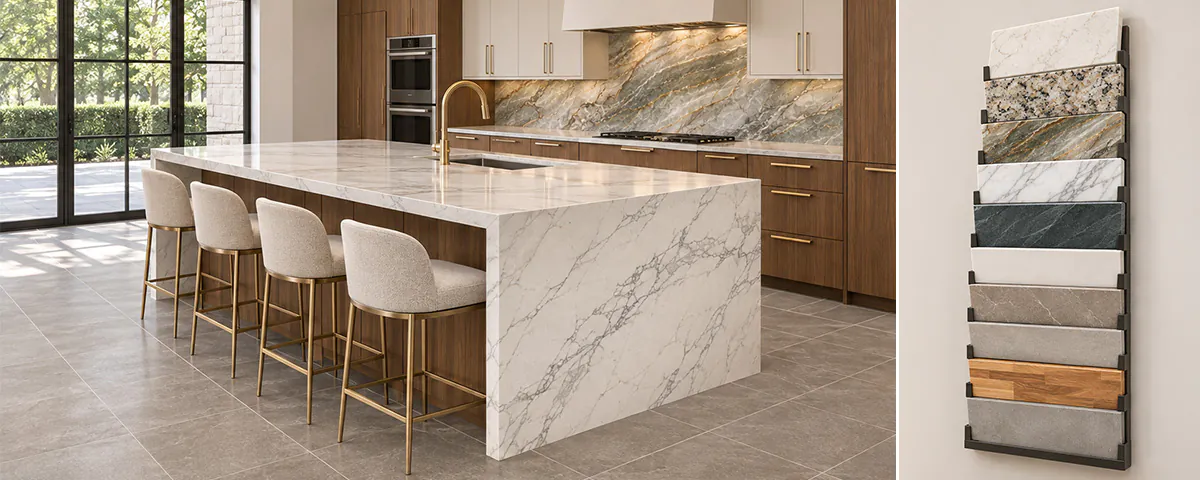
All these kinds of kitchen countertops sort into four groups, based on how each one is made.
|
GROUP |
MATERIALS |
HOW IT’S TYPICALLY MADE |
|---|---|---|
|
Natural stone |
Granite, quartzite, marble, soapstone |
Quarried from the earth and cut into slabs |
|
Engineered (manufactured) |
Quartz, solid surface |
Minerals mixed with a binder, a glue-like ingredient, and formed in a factory |
|
Porcelain and sintered |
Porcelain, sintered surfaces |
Clay or mineral powders baked at intense heat |
|
Other materials |
Laminate, butcher block and wood, concrete, tile, stainless steel |
Varies: wood, metal, cast concrete, set tile, or a printed layer on a core |
Countertop Materials Compared by Durability
Countertop durability depends on what you need to protect against: scratches, heat, stains, or chips. No surface resists all four perfectly, so match the material to how you cook. Most makers and the Natural Stone Institute recommend trivets for hot cookware.
| MATERIAL | WHAT THE NATURAL STONE INSTITUTE AND MAKERS TYPICALLY ADVISE |
|---|---|
| Granite | Most granite doesn’t need sealing; sealing adds stain resistance, not stain-proofing |
| Marble | Sealing often makes sense; keep acids like lemon off it |
| Quartzite, soapstone | Ask your stone supplier about sealing |
| Quartz | No sealing; resists scratches, but isn’t scratch-proof or chip-proof |
| Solid surface | Nonporous; protect from direct heat |
| Porcelain | No sealing; hard knocks can crack it |
| Laminate | Use a cutting board; skip abrasive or acidic cleaners |
| Stainless steel | Nonporous; avoid bleach, chloride cleaners, and scouring powders |
Compare durability in detail in Most Durable Countertop Material.
How Much Do Different Types of Countertops Cost?
The cost of different types of countertops depends on the material, size, edge style, and installation labor. Laminate and tile typically sit at the lower end, quartz and granite in the middle, and marble and quartzite toward the top, though ranges overlap.
At i4 Kitchen & Bath, those same four factors shape our pricing.
| TYPICAL PRICE LEVEL | MATERIALS |
|---|---|
| Lower | Laminate, tile |
| Mid-range | Quartz, granite, solid surface |
| Higher | Marble, quartzite |
| Varies widely by product | Butcher block and wood, concrete, stainless steel, porcelain, sintered surfaces, soapstone |
Think of these levels as a rough guide, based on general estimates reported across the industry. A premium slab of one material can cost more than a basic slab of another.
See price ranges in Countertop Cost Comparison.
Kitchen Counter Materials: Choosing by Budget, Style & Durability
Most kitchen counter material options come down to budget, style, and durability. Once cost and care narrow your list, look and texture help you choose.
Weigh all three in How to Choose the Right Countertop Material.
Different Styles of Kitchen Countertops
Different styles of kitchen countertops usually follow your kitchen’s design style. Traditional kitchens often pair veined stone with a softly rounded bullnose edge or an S-shaped ogee edge. Farmhouse kitchens lean toward warm wood or a matte, honed finish. Transitional kitchens, a blend of classic and modern, often use marble-look quartz with a clean, slightly rounded eased edge. Industrial designs favor concrete looks or stainless steel. In the Van Brussel family’s kitchen, we paired quartz with light gray shaker cabinets, a simple framed-door style, and carried it up the wall as a full backsplash.
Explore color ideas in Green Kitchen Countertops (and Other Popular Colors).
Kitchen Counter Texture and Finish
Kitchen counter texture comes from the finish, and it shapes how your countertop looks and feels every day. The Natural Stone Institute lists polished, honed, leathered, and antiqued among the finishes available for natural stone. In plain terms:
• Polished: glossy and reflective, with a mirror-like shine.
• Honed: smooth and matte, without the shine of polished stone.
• Leathered: a soft texture you can feel under your fingertips.
• Antiqued: textured to look gently worn, like old stone.
Quartz usually comes in polished or matte finishes, and some designs add texture. Matte surfaces cut glare under bright kitchen lights. The finish doesn’t change which cleaner you use, the Institute notes, so pick the one you love to touch. Check samples under your own kitchen lighting before you decide.
Kitchen Island Materials
Your island often does three jobs: prep space, seating, and focal point. That makes its countertop a decision of its own, starting with whether to match.
Plan overhangs and seating in Kitchen Countertop Height, Thickness & Sizing.
Should Your Island Use the Same Countertop Material?
Your island doesn’t have to use the same countertop material as the rest of the kitchen. Matching usually suits smaller kitchens or busy cabinet and floor patterns, where one surface keeps things calm. A contrasting island works well when you want a focal point, as long as the difference looks intentional.
In the Eads family’s kitchen, the island and perimeter share the same white countertop, while a rich brown island base stands out against crisp white cabinets. The matching surface keeps the room calm, and the cabinet contrast still makes the island the focal point.
Can You Mix Different Countertop Materials in Your Kitchen?
Mixing countertop materials works best when one surface leads and the other supports it. A bold, veined island pairs well with a quieter perimeter, or the reverse. Repeating a shared element, such as cabinet color or hardware, ties them together. Check each surface’s care needs, since the higher-maintenance one may show wear first. Using a premium stone only on the island can also help your budget, since the island is usually smaller than the perimeter.
FAQs
Once you start comparing materials, questions about durability, upkeep, sealing, heat, and stone usually follow.
What Are the Different Types of Kitchen Countertops?
The different types of kitchen countertops range from granite and quartz to porcelain, laminate, and wood, plus a few less common natural stones. Slate is generally resistant to kitchen acids, like granite, while limestone and travertine are acid-sensitive, like marble, according to the Natural Stone Institute.
Which Is Better for Kitchen Countertops?
No countertop is better for every kitchen: if low upkeep matters most, quartz typically needs no sealing. If you want one-of-a-kind character, natural stone delivers it, since no two slabs match. If budget leads, laminate and tile typically cost less.
Find your match in How to Choose the Right Countertop Material.
What Is the Most Durable Countertop Material?
The most durable countertop material depends on the wear you expect. The Natural Stone Institute describes quartzite as generally harder and denser than granite, and quartz makers say their surfaces resist scratches but aren’t chip-proof. No surface is proof against scratches, heat, stains, and chips all at once.
Compare each surface in Most Durable Countertop Material.
What Is the Easiest Countertop to Maintain?
Nonporous surfaces are usually the easiest countertops to maintain. Quartz makers say their surfaces need no sealing or polishing, just mild soap and water, and solid surface is nonporous too. Natural stone asks a little more: some stones benefit from sealing, and marble needs care around acids, according to the Natural Stone Institute.
See low-maintenance options in Most Durable Countertop Material.
What Countertops Do Not Need Sealing?
Quartz and porcelain typically don’t need sealing, according to their makers. Most granite doesn’t either, according to the Natural Stone Institute, though a sealer can add stain resistance. For quartzite and soapstone, ask your stone supplier, since needs vary by slab.
Check sealing needs by material in Most Durable Countertop Material.
What Countertops Are Most Heat Resistant?
Natural stone and porcelain typically handle heat well. The Natural Stone Institute says many stones can withstand heat, and some porcelain makers say hot cookware can go directly on their surfaces. Makers of quartz, solid surface, and laminate warn against setting hot pans down directly, and a trivet is still the safest habit on any countertop.
See how heat affects each surface in Most Durable Countertop Material.
What Is the Difference Between Quartz and Quartzite?
The difference between quartz and quartzite is how they’re made. Quartz countertops are engineered in a factory from minerals and a binder, while quartzite is a natural stone quarried from the earth. The Natural Stone Institute warns not to confuse the two.
See every difference in Quartz vs. Quartzite
What Are the Most Popular Types of Stone Countertops?
Common natural stone countertop choices include granite, quartzite, marble, and soapstone. Granite forms from cooled molten rock, while marble, quartzite, and soapstone form when existing rock is reshaped by heat and pressure, according to the Natural Stone Institute’s classification and the U.S. Geological Survey, the federal science agency.
Compare them in Types of Stone Countertops.
Conclusion
You don’t need to know every material by heart. Shortlist two or three that fit your budget, style, and cooking habits, then see them side by side as full slabs. Our design team, with over 80 years of combined experience, can help you decide. Narrow your shortlist with How to Choose the Right Countertop Material.
Visit Our Orlando Showroom & Get Inspired
If you’re in Central Florida, explore granite, quartz, and more at i4 Kitchen & Bath, the largest kitchen and bath showroom in Orlando.
Schedule a free consultation by calling (407) 246-0636 or filling out a contact form.
References
- Natural Stone Institute, Care & Cleaning of Natural Stone (brochure, © 2019). https://associationdatabase.com/aws/NSI/asset_manager/get_file/923132
- Natural Stone Institute, Statement of Position on Sealing Natural Stone Countertops (adopted 2006). https://www.naturalstoneinstitute.org/consumers/sealing-stone/
- Cambria, About Cambria FAQs. https://www.cambriausa.com/quartz-countertops/faq/about-cambria
- Cambria, Product Care FAQs. https://www.cambriausa.com/quartz-countertops/faq/product-care
- Cambria, Quartz Finishes and Textures. https://www.cambriausa.com/quartz-countertops/finishes-textures
- Cosentino, Silestone Use & Care (rev. 02, 07/2021). https://assetstools.cosentino.com/api/v1/bynder/doc/CC9D1C3D-CF72-4496-B66951C29CA8B2C3/si-use-and-care-enesptdeitsefrnl.pdf
- Corian Design, Corian Solid Surface Product Bulletin. Catalog hosted by distributor ArchiExpo. https://pdf.archiexpo.com/pdf/corian/corian-product-overview/96-377168.html
- Caesarstone, Cleaning Porcelain Countertops: All You Need to Know (2023). https://www.caesarstone.com/blog/cleaning-porcelain-countertops-all-you-need-to-know/
- Wilsonart, Wilsonart Laminate Care & Maintenance. Hosted by distributor Lowe’s. https://pdf.lowes.com/useandcareguides/688598215633_use.pdf
- Euro Inox, Frequently Asked Questions: Cleaning Stainless Steel in the Home (2011). Hosted on worldstainless.org. https://worldstainless.org/wp-content/uploads/2025/02/Cleaning_steel_home_EN.pdf
- Oxford Learner’s Dictionaries, worktop. https://www.oxfordlearnersdictionaries.com/definition/english/worktop
- Wilsonart, Wilsonart HD Laminate Technical Data (rev. February 15, 2019). https://images.wilsonart.com/media/Technical_Resources/en/highdefinitiontechdata.pdf
- John Boos & Co., Caring for countertops & worktops. https://www.johnboos.com/care-and-maintenance/kitchen-countertops
- Dal-Tile Corporation, Tile Care & Maintenance guide. Hosted by distributor Home Depot, undated. https://images.homedepot-static.com/catalog/pdfImages/53/5395e37f-d666-4092-ba3a-fae31ec436f7.pdf
- Jeffrey Girard, P.E., founder of The Concrete Countertop Institute, Which Concrete Countertop Casting Method is Best for the Job? Concrete Decor (January 2015). https://www.concretedecor.net/departments/concrete-countertops/countertop-casting-which-method-is-best-for-the-job/
- U.S. Geological Survey, What are igneous rocks? https://www.usgs.gov/faqs/what-are-igneous-rocks